U.S. freshwater · Beginner guide
Fishing a river
Choose reachable current from the bank, decide what the rig should do, and follow its path before searching farther.
Reviewed October 20, 2026 · Confirm species, access and current rules for your actual water.
Choose a reach you can use
Confirm the real entrance, fishing permission and water-specific rules. Choose an established bank position with stable footing, a way to land a fish and a clear exit. The far bank and the fastest channel do not have to be part of your first plan.
Observe where the current goes before casting. Apparent calm does not establish safe entry; stay on the bank when depth, footing or current is uncertain. A place called a river does not automatically require a heavier sinker.
Sources: National Park Service: river and stream safety (opens in a new tab)
Choose a current edge within reach
A seam is the boundary between differently moving water. Shelter beside food-carrying flow can be worth investigating, but you still need a documented target and a usable position.
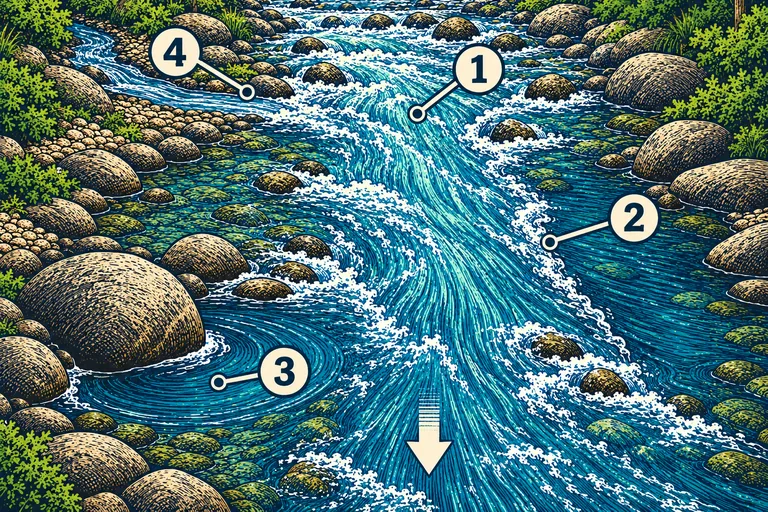
- 1 · Faster main flow
- Watch how quickly it carries surface material. Treat it as context, not an instruction to enter or reach across it.
- 2 · Current seam
- Compare a presentation alongside the speed change with one outside it, if both are reachable from your position.
- 3 · Eddy
- The sheltered water downstream of the boulder moves differently from the main flow. Its edge may offer a useful presentation lane; it is not proof of safe footing.
- 4 · Tributary mouth
- Meeting flows create another change to observe. Check local closures or protected areas before fishing a tributary junction.
For the basic riffle, run and pool vocabulary, read the creek habitat guide.
Sources: NYDEC: where to fish in rivers and streams (opens in a new tab)
Decide what the rig should do
These are starting choices for documented species. A drifting or retrieved presentation and a rig held on the bottom need different decisions.
Trout
With a suitable spinner, cast slightly upstream and recover slack as the current carries it. Follow the selected lure’s retrieve instructions and the water’s artificial-lure and hook rules.
Smallmouth bass
Try a compatible jig or soft plastic beside reachable rock cover or a current edge. Vary the retrieve and angle rather than assuming every river fish needs a stationary bait.
Channel catfish
A sliding-sinker presentation with permitted bait aims to hold near the bottom. Choose only enough weight for that presentation while keeping the finished baited rig within the rod’s range.
Sources: ODFW: how to fish for trout (opens in a new tab) · Missouri conservation: smallmouth bass fishing (opens in a new tab) · NYDEC: fishing for channel catfish (opens in a new tab)
Follow the cast through the current
Before adding weight, decide the path you want: a lure swimming beside a seam, a controlled drift, or bait held on the bottom. Watch where the line and presentation travel from your casting position.
Recover enough slack to stay in contact without unintentionally dragging the lure out of its intended lane. Change the cast angle or retrieve, then evaluate whether a different weight is needed for that particular method.
Keep the linked tackle sizes and rig instructions together. If the current defeats the documented setup, try a permitted slower-water position or another verified system. A heavier sinker alone is not a complete solution, and an unweighed baited rig is not a verified casting load.
Read a gauge without guessing the depth
Check the relevant station, its observation time and the trend, plus local warnings and release information where applicable. A nearby station is not necessarily on the same reach or affected in the same way.
USGS gage height, or stage, is water height above that station’s reference datum. Discharge describes the volume passing the station per unit time. Neither number gives the depth under your feet or certifies a crossing.
Use observations as context for a local decision. There is no nationwide stage or flow value that makes wading safe, and the absence of a flood warning does not establish suitable fishing conditions.
Know when to change the outing
- Stay out of floodwater and leave promptly if water rises or your exit becomes uncertain.
- Avoid strainers, unstable banks, slippery edges and gaps between rocks. Wear an appropriate, properly fitted life jacket where falling into the water is a risk.
- Keep away from dams, spillways and waterfalls. Low-head dams can create trapping recirculating currents even when the structure looks small.
- If the reach or weather is unsuitable, choose another permitted location or postpone. Changing tackle does not resolve an unsafe outing.
Sources: National Park Service: river and stream safety (opens in a new tab) · National Weather Service: flood safety (opens in a new tab) · National Weather Service: low-head dam hazards (opens in a new tab)
Put the plan into practice
Keep your chosen fish and set the Matcher to river fishing. Update the clarity and conditions yourself; this guide does not know the water’s current conditions.