Fish guide
Chinook salmon
The biggest of the Pacific salmon: chinook grow up at sea, in the Great Lakes or in a few big reservoirs, and run up rivers to spawn, and a fresh king on a river is the fish of a lifetime for many anglers.
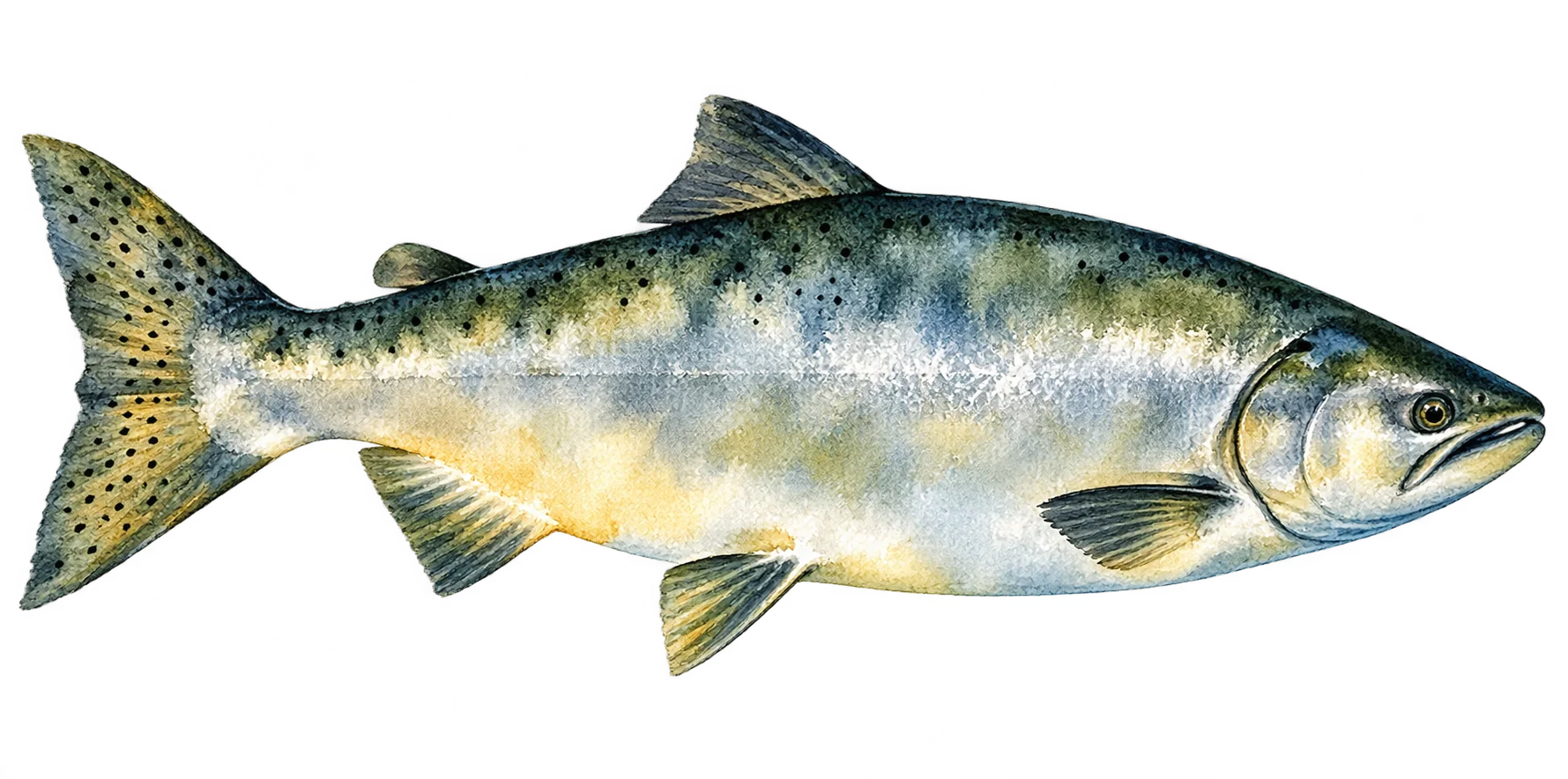
Oncorhynchus tshawytscha · also called king salmon, king, spring salmon, blackmouth (a young king that stays near shore), tyee (a king of 30 lb or more)
How to tell it
- Black spots on the back and on both lobes of the tail.
- A black mouth with black gums at the base of the teeth (a coho has white gums).
- Silver and bright when fresh from the sea or lake; darker, olive to maroon, after time in the river.
Size: Most are 10–30 lb in rivers; 40-pound fish come every year in Alaska and the Pacific Northwest, and the sport-fishing record is 97 lb 4 oz.
What to throw
The first pick and the backup for every water clarity and light, from the Gear Matcher. Tap one to see the whole kit.
River · Transition water (50–65°F)
Clear water · see 4 ft+ down
Stained water · 1–4 ft of sight
Murky water · under 1 ft
Rain fishes like a cloudy day, so it is left out. These are the everyday picks: in spring and fall the Gear Matcher adds the season’s patterns for some fish.
Our picks for these
- Large Inline Spinner: Blue Fox Vibrax spinner, #6, 5/8 oz, silver/blue
- Cured Roe or Egg Sac Drifted near the Bottom: Pautzke Balls O' Fire cured salmon eggs, 1 oz
- Large Casting Spoon: Acme Kastmaster spoon, 3/4 oz, gold/neon red
- Cured Roe or Egg Sac under a Lighted Bobber: QualyQualy lighted slip bobbers, 5 pack
- Glow Casting Spoon: IRON DECOY glow spoon, 1 oz, wonderbread
- Spin-N-Glo Drift Bobber with Yarn or Roe: Yakima Spin-N-Glo, #12, flame chartreuse, 12 pack
Rod, reel and line
- Rod
- 8'6"–10'6" medium-heavy salmon rod
- Reel
- 3000–4000 spinning, or a line-counter baitcaster for trolling
- Line
- 15–25 lb monofilament or 30–65 lb braid
- Leader
- 15–20 lb fluorocarbon leader
Kings are the biggest salmon. A long, strong rod handles their runs, and heavy line lands them before they tire out.
Where and when
River fishing: plan your approach and read the water.
- Where they live
- The Pacific coast rivers from California to Alaska, the Great Lakes and their rivers, and a few big Western reservoirs. In the river they hold in deep holes, runs and tailouts.
- Water they like
- Cold water: about 45–60°F in the river. Warm, low water slows the run.
- Best time
- Dawn and dusk, low light, and a fresh rise in the river after rain that brings new fish in.
- Spawning
- Most runs spawn in late summer and fall, in the gravel of the river where they were born; some rivers have spring, summer and winter runs too. All Pacific salmon die after spawning.
Through the year
Best months for chinook salmon: September–October.
- January: slower.
- February: slower.
- March: slower.
- April: slower.
- May: slower.
- June: good.
- July: good.
- August: good.
- September: best.
- October: best.
- November: good.
- December: slower.
Runs differ by river, and many have strict seasons: check the rules before you go. Spring runs come in some Pacific rivers.
A general pattern, not a local forecast. Ice, runs, stocking and the rules set the season for chinook salmon, water by water.
Spring
Spring-run kings in some rivers (often with strict rules): drift eggs or swing spoons through the holes.
Summer
Kings in the Great Lakes and at sea; early runs start up the rivers in late summer.
Fall
The main run: kings fill the rivers. Spoons and spinners swung through deep runs, and drifted roe where it is legal.
Winter
Fall-run kings have spawned and died; some rivers have winter runs or a few late fish.
Tips
- 1.Read the rules before every trip: seasons, closures, tags and gear rules change from river to river and year to year.
- 2.Fish the deep, slower runs and tailouts where kings rest on their way up.
- 3.Use heavy enough gear to land them fast: a long fight on light gear exhausts a fish that will be released.
The rules
Salmon seasons, licenses, and stamps are strict. Many rivers are closed or have special gear rules. Check local regulations.
Through the ice
What to drop
Jigging Spoon (glow or silver) with a Minnow Head
or Tube Jig
- Rod
- 30"–36" medium ice rod
- Reel
- 2500 spinning
- Line
- 10–12 lb monofilament
How thick the ice must be
- Under 4"Stay off
- 4"Ice fishing and anything on foot
- 5–7"Snowmobile or ATV
- 8–12"Car or small pickup
- 12–15"Medium truck
For new, clear ice. White or snowy ice is about half as strong, so double these. Check it with a spud bar or auger as you go out, and keep off ice over moving water, near inlets and at pressure ridges. No ice is completely safe.