Fish guide
Trout
Cold-water fish of mountain streams, spring creeks and cool lakes, and among the most stocked fish in America: many states release rainbows into lakes and streams in spring and fall.
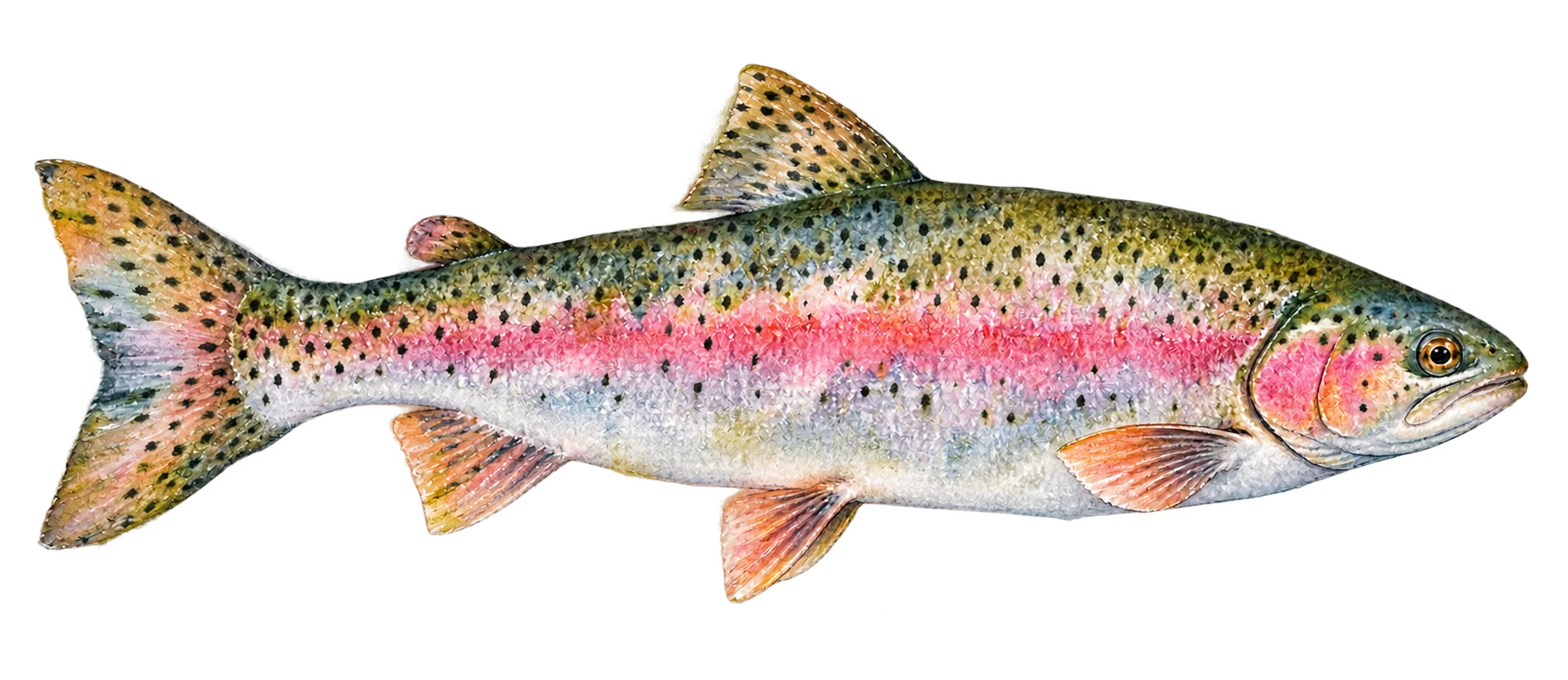
This guide covers rainbow, brown and brook trout (a char), three species: Oncorhynchus mykiss, Salmo trutta, Salvelinus fontinalis · also called steelhead (sea-run rainbows), German brown, brookie
How to tell it
- Rainbow: a pink or red band along the side, and small black spots over the back, the dorsal fin and the tail.
- Brown: golden brown with black and red spots, often ringed with pale halos.
- Brook: a dark green back with pale, wormlike markings, and white-edged lower fins.
Size: Stocked rainbows are usually 9–12 inches. Wild stream trout are often smaller; lake and tailwater fish can pass 5 pounds.
What to throw
The first pick and the backup for every water clarity and light, from the Gear Matcher. Tap one to see the whole kit.
River · Transition water (50–65°F)
Clear water · see 4 ft+ down
Stained water · 1–4 ft of sight
Murky water · under 1 ft
Rain fishes like a cloudy day, so it is left out. These are the everyday picks: in spring and fall the Gear Matcher adds the season’s patterns for some fish.
Our picks for these
- Inline Spinner: Mepps Aglia plain treble spinner, #1 (1/8 oz), silver
- Small Spoon: Acme Kastmaster, 1/8 oz, chrome
- Inline Spinner: Mepps Aglia plain treble spinner, #1 (1/8 oz), gold
- Black Inline Spinner: Worden's Rooster Tail, 1/8 oz, black
- Nightcrawler on the Bottom: Eagle Claw baitholder hooks, #8 bronze, 10 pack
- Spoon: Acme Little Cleo, 1/8 oz, gold/fluorescent stripe
- Inline Spinner: Mepps Aglia plain treble spinner, 1/8 oz, hot orange/chartreuse
Rod, reel and line
- Rod
- 6'–7' ultralight spinning
- Reel
- 1000 spinning
- Line
- 4 lb fluorocarbon (6 lb in murky water)
Trout are line-shy, and ultralight gear casts small lures far and makes every fish fun.
Where and when
River fishing: plan your approach and read the water.
- Where they live
- Clean, cold water with plenty of oxygen: the riffles, runs and pools of streams, and the cool depths of lakes in summer.
- Water they like
- Best from 50 to 65°F. Above about 70°F they are stressed and a caught trout may not survive release: fish early in the cool of the morning, or leave them be until the water cools.
- Best time
- Low light: dawn, dusk and overcast days, and right after a rain.
- Spawning
- Rainbows spawn in spring; brown and brook trout in fall, on gravel beds in streams. Stay off the gravel and let spawning fish be.
Through the year
Best months for trout: April–May and October.
- January: slower.
- February: slower.
- March: good.
- April: best.
- May: best.
- June: good.
- July: slower.
- August: slower.
- September: good.
- October: best.
- November: good.
- December: slower.
Spring and fall stocking are the busiest times in many states. In many Southern lowland waters, trout are stocked in winter instead; mountain streams and cold tailwaters fish all year. In summer, fish early and late, or deep in lakes.
A general pattern, not a local forecast. Pick your state: many Southern lowland waters stock trout for winter instead.
Spring
Stocking season and rising water: small spinners, spoons and bait drifted through the runs.
Summer
Fish early and late. In lakes they go deep, so troll or fish bait near the bottom; in streams, look for shade and cold springs.
Fall
Fall stocking, and big browns on the move before they spawn: streamers and small jerkbaits.
Winter
Slow and deep in streams; through the ice on lakes, small jigs and spoons tipped with bait.
Tips
- 1.Light line (4 lb) and small lures: trout are line-shy.
- 2.In a stream, come from downstream and stay low: trout face into the current.
- 3.Wet your hands before you handle a trout you will let go.
The rules
Seasons, size and bag limits for this fish differ from state to state, and from water to water. Check local regulations.
Through the ice
What to drop
Small Jigging Spoon tipped with a Wax Worm
or PowerBait or a Worm under a Tip-Up
- Rod
- 26"–28" ultralight ice rod
- Reel
- 500 spinning
- Line
- 4 lb fluorocarbon
How thick the ice must be
- Under 4"Stay off
- 4"Ice fishing and anything on foot
- 5–7"Snowmobile or ATV
- 8–12"Car or small pickup
- 12–15"Medium truck
For new, clear ice. White or snowy ice is about half as strong, so double these. Check it with a spud bar or auger as you go out, and keep off ice over moving water, near inlets and at pressure ridges. No ice is completely safe.