Fish guide
Spotted bass
The black bass of the South’s clear reservoirs and rocky rivers: spotted bass look like largemouth, fight like smallmouth, and often hold deeper and in more current than largemouth.
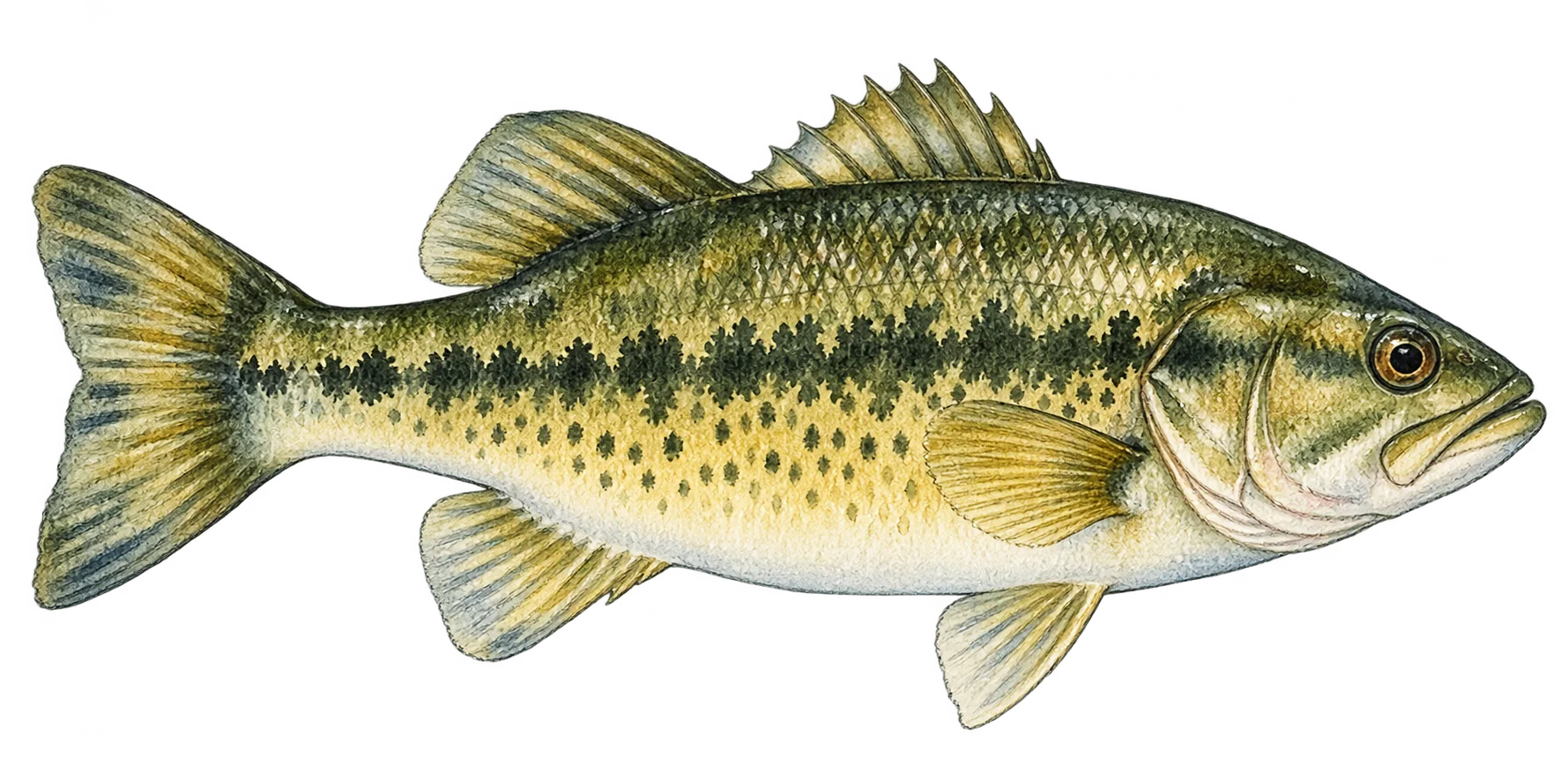
Micropterus punctulatus · also called spot, Kentucky bass, spotted black bass
How to tell it
- Rows of small dark spots along the lower side, below a blotchy dark stripe.
- The upper jaw ends at or just before the back of the eye (a largemouth’s reaches past it).
- Often a rough patch of teeth on the tongue (not every spot has one), and the two parts of the dorsal fin joined by a shallow notch.
Size: Most are 10–16 inches and 1–2 lb. A 4-pound spot is a trophy. The 10-pound “spots” of California and Georgia reservoirs are Alabama bass, a close cousin.
What to throw
The first pick and the backup for every water clarity and light, from the Gear Matcher. Tap one to see the whole kit.
Lake · Transition water (50–65°F)
Clear water · see 4 ft+ down
Stained water · 1–4 ft of sight
Murky water · under 1 ft
Rain fishes like a cloudy day, so it is left out. These are the everyday picks: in spring and fall the Gear Matcher adds the season’s patterns for some fish. Spotted bass are fished like largemouth bass here, so these are its picks.
Our picks for these
- Ned Rig or Senko: Z-Man Ned Rig Kit, green pumpkin
- Drop Shot Rig: Roboworm Straight Tail Worm, 4.5 in, Aaron's Magic
- Suspending Jerkbait: Rapala X-Rap XR10, silver
- Senko: Yamamoto Senko, 5 in, green pumpkin
- Black Spinnerbait (Colorado blade): BOOYAH Moon Talker, black/blue
- Black / Blue Jig: Strike King Tour Grade skipping jig, 3/8 oz, black/blue
- Spinnerbait: BOOYAH Blade Double Willow, white/chartreuse
- Squarebill Crankbait: Strike King KVD 1.5 squarebill, 3/8 oz, natural bream
- Bladed Jig (ChatterBait): Z-Man Original ChatterBait, 3/8 oz, chartreuse sexy shad
- Bladed Jig (ChatterBait): Z-Man Original ChatterBait, 3/8 oz, black/blue
- Texas-Rigged Creature Bait: Yamamoto Kreature, 4 in, black with blue flake, 7 pack
Rod, reel and line
- Rod
- 7' medium-heavy casting
- Reel
- Baitcasting, 6.4–7.1:1
- Line
- 12–15 lb fluorocarbon
A medium-heavy rod has the backbone to pull bass out of cover, and fluorocarbon is hard for them to see.
For finesse baits (Ned rigs, Senkos, drop shots)
- Rod
- 7' medium spinning
- Reel
- 2500 spinning
- Line
- 8 lb fluorocarbon
Ned rigs, Senkos and drop shots are light baits. A spinning rod casts them easily and light line helps them fall naturally.
For frogs in heavy cover
- Rod
- 7'3"–7'6" heavy casting
- Reel
- Baitcasting, 7.1–8.1:1
- Line
- 50–65 lb braid
Frogs are fished in the thickest cover. A heavy rod and braid that does not stretch drive the hook home and pull the bass out of the weeds.
Where and when
Lake fishing: plan your approach and read the water.
- Where they live
- Clear, rocky reservoirs and creeks and rivers with current. They like steep bluffs, points and rock, and suspend over deep water more than largemouth do.
- Water they like
- Most active from 60 to 78°F, and they keep feeding in colder water than largemouth.
- Best time
- Early morning and evening, and windy days; in clear reservoirs, cloudy days help.
- Spawning
- In spring, from the upper 50s to the low 70s °F, males fan nests on gravel and rock, a little deeper than largemouth do.
Through the year
Best months for spotted bass: March–April and October–November.
- January: good.
- February: good.
- March: best.
- April: best.
- May: good.
- June: good.
- July: slower.
- August: slower.
- September: good.
- October: best.
- November: best.
- December: good.
Earlier in the South and later in the North. Spots keep biting in winter, on steep, rocky banks.
A general pattern, not a local forecast. Pick your state for a rough adjustment: spotted bass follow the water’s warmth, earlier in the South and later in the North.
Spring
They move up onto points and gravel banks to spawn: shaky heads, small swimbaits and jerkbaits.
Summer
Deep: on points, ledges and brush 15–30 feet down, or chasing shad near the surface early. Drop shots and deep cranks.
Fall
They follow the shad into the creeks and chase on top: topwater and swimbaits.
Winter
Still feeding, on steep banks and bluffs: a jerkbait, a blade bait or a small jig.
Tips
- 1.Fish deeper than you would for largemouth, and on rock rather than weeds.
- 2.Go lighter: spotted bass in clear water bite finesse baits on light fluorocarbon best.
- 3.Learn the local rules: where spotted or Alabama bass were brought in, some states ask you to keep them, to protect native bass.
The rules
Shoal bass live in only a few southeastern rivers and have special rules. Check local regulations.