Fish guide
Striped bass
Native to Atlantic coastal rivers, and stocked into big reservoirs and rivers across the South and West, where stripers run in schools after the shad and fight like nothing else in fresh water.
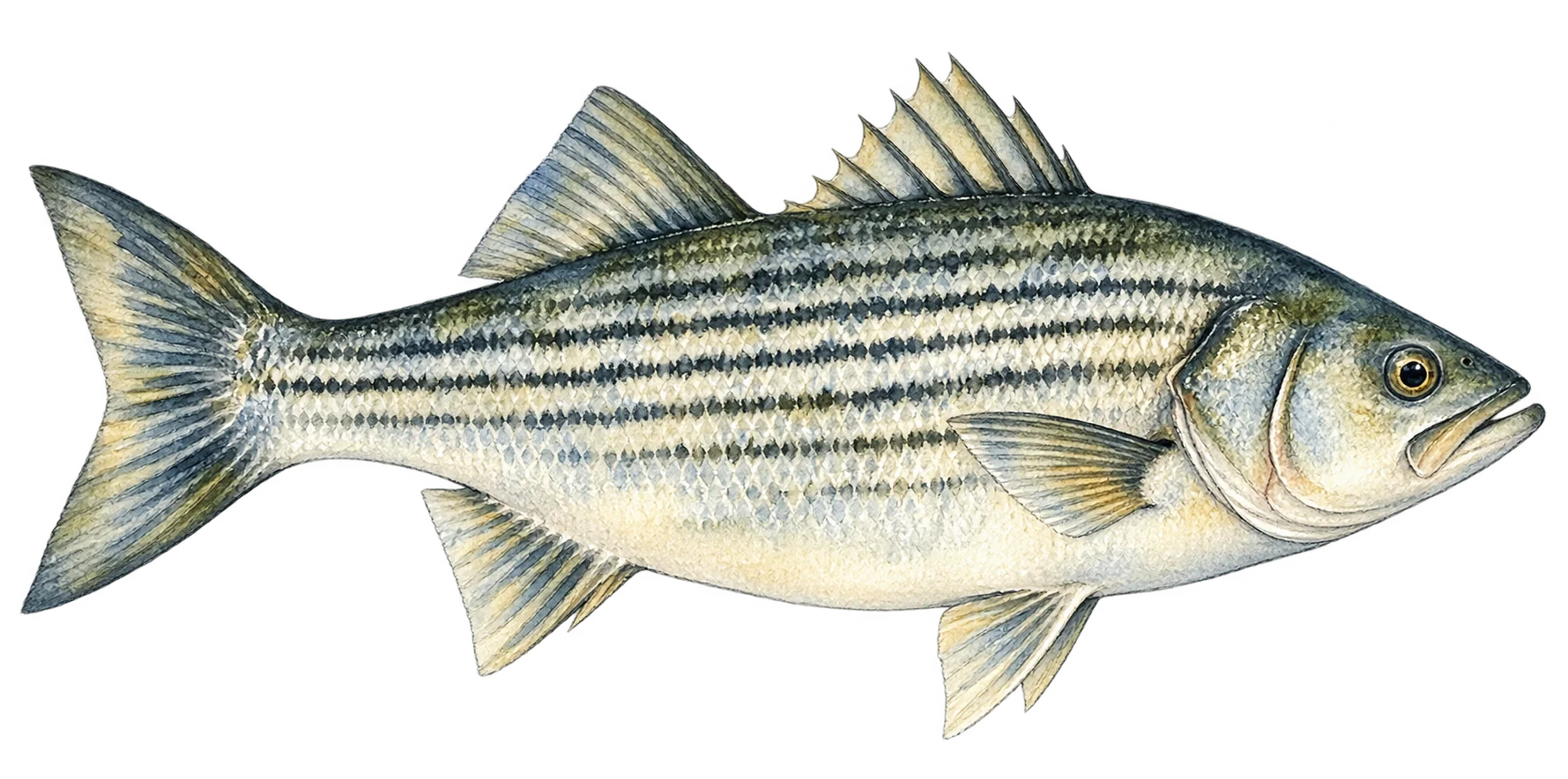
Morone saxatilis · also called striper, rockfish, linesider
How to tell it
- Silver sides with 7–8 dark, unbroken lines from the gills to the tail.
- Two separate dorsal fins and a forked tail.
- Hybrid stripers (wipers) are chunkier, often with broken lines: use more than one sign.
Size: Reservoir stripers are often 5–15 pounds; the best lakes give up fish over 30.
What to throw
The first pick and the backup for every water clarity and light, from the Gear Matcher. Tap one to see the whole kit.
Lake · Transition water (50–65°F)
Clear water · see 4 ft+ down
Stained water · 1–4 ft of sight
Murky water · under 1 ft
Rain fishes like a cloudy day, so it is left out. These are the everyday picks: in spring and fall the Gear Matcher adds the season’s patterns for some fish.
Our picks for these
- Swimbait: Storm WildEye Swim Shad, 5 in, Shad, 3 pack
- Jigging (Slab) Spoon: Bomber Slab Spoon, 1 1/4 oz, silver
- Bucktail Jig: SPRO bucktail jig, 1/2 oz, white
- Swimbait near Lights: Storm WildEye Swim Shad, 4 in, 7/16 oz, pearl, 3 pack
- Cut Bait or Anchovies on the Bottom: Striped bass rigs, 6/0 inline circle, 6 pack
- Swimbait: TRUSCEND Shadtale pre-rigged swimbait, 4 in, 5/8 oz
- Bucktail Jig: SPRO bucktail jig, 1/2 oz, sand eel green
Rod, reel and line
- Rod
- ~7' medium-heavy
- Reel
- 3000–4000 spinning
- Line
- 15–20 lb braid or monofilament
- Leader
- Optional 20 lb fluorocarbon leader in clear water
Stripers are strong, fast fighters. Heavier gear than black bass keeps them from breaking off.
Where and when
Lake fishing: plan your approach and read the water.
- Where they live
- Big, open water: main-lake points, humps, river channels and the tailwaters below dams, wherever the shad are.
- Water they like
- Best from 55 to 70°F; in summer they go deep for cooler water with enough oxygen.
- Best time
- Dawn and dusk, and at night under lights in summer.
- Spawning
- Spring, in long rivers with current, at about 60–65°F. In most reservoirs they cannot spawn, so they are stocked (a few, like Lake Texoma, sustain themselves).
Through the year
Best months for striped bass: March–May and October–December.
- January: good.
- February: good.
- March: best.
- April: best.
- May: best.
- June: good.
- July: slower.
- August: slower.
- September: slower.
- October: best.
- November: best.
- December: best.
Earlier in the South and later in the North. In summer, fish at dawn, or deep.
A general pattern, not a local forecast. Pick your state for a rough adjustment: striped bass follow the water’s warmth, earlier in the South and later in the North.
Spring
Runs up the rivers, and points: bucktails, swimbaits and live bait.
Summer
Deep and early: live shad on downlines, and topwater blitzes at dawn.
Fall
Schools chase shad near the surface: watch for gulls and breaking fish, then cast spoons, swimbaits and topwater.
Winter
Following the shad into creek arms and warm-water outflows: swimbaits and bucktails, slowly.
Fishing live bait
Live bait is one of the most reliable ways to catch reservoir stripers. Find them first (diving birds, bait or fish on the sonar, main-lake points and river channels), then put a lively baitfish where they are.
Downline
Summer and winter, when stripers are deep
A 1–2 oz egg sinker above a swivel, then 6–8 ft of 12–20 lb fluorocarbon and a circle hook through the bait’s lips. Lower it straight down to the depth where the sonar shows fish or bait, and hold it there.
Free line
Spring and fall, and at dawn, when they are shallow
No weight at all: a circle hook through the lips or just behind the back fin, and let the bait swim 50–100 ft behind a slowly moving boat.
Planer board
Shallow fish that spook from the boat
A free line clipped to a planer board, which pulls the bait out to the side, over flats and points the boat never crosses.
From the bank
No boat: points, and below dams
A sliding sinker above a swivel, a 2–3 ft leader and a circle hook (a Carolina rig): cast a live or cut bait out and let it sit on the bottom.
The bait
Gizzard and threadfin shad, blueback herring or big shiners: whatever the stripers eat in that water. Catch shad with a cast net, or buy bait where it is sold. Many states limit which baitfish you may use, and moving them from one water to another: check the rules before you go.
Hooking them
Circle hooks, about 1/0–3/0 for shad and herring. When the rod bends over, do not jerk it: reel steadily and the hook usually sets itself in the corner of the mouth, where it is easier to remove for a release.
Keeping bait alive
A round, aerated bait tank (in a square one, bait piles into the corners and dies), cool water with a little non-iodized salt in it, and not too many baits at once. Change some of the water through the day.
What it takes
Each opens an Amazon search: pick one with good reviews.
- Aerated bait tank
- Circle hooks, 1/0–3/0
- Egg sinkers, 1–2 oz
- Fluorocarbon leader, 15–20 lb
- Cast net for bait
- Planer boards
For striped bass on lures instead, see the picks above.
Tips
- 1.Follow the birds: gulls diving on the water mean bait, and stripers under it.
- 2.Heavier gear than for bass: a striper will strip line and break light tackle.
- 3.In summer, let them go fast: a striper brought up from cool depths into warm surface water is stressed.
The rules
Seasons, size and bag limits for this fish differ from state to state, and from water to water. Check local regulations.
Through the ice
What to drop
Jigging (Slab) Spoon
or Live Shad or Minnow under a Tip-Up
- Rod
- 30"–36" medium ice rod
- Reel
- 2500 spinning
- Line
- 10–12 lb monofilament
How thick the ice must be
- Under 4"Stay off
- 4"Ice fishing and anything on foot
- 5–7"Snowmobile or ATV
- 8–12"Car or small pickup
- 12–15"Medium truck
For new, clear ice. White or snowy ice is about half as strong, so double these. Check it with a spud bar or auger as you go out, and keep off ice over moving water, near inlets and at pressure ridges. No ice is completely safe.