U.S. freshwater · Beginner guide
Fishing a creek
Read a short stretch of water, make a few deliberate casts, and choose gear for the fish that actually live there.
Reviewed October 20, 2026 · Regional examples are labeled; local access and rules still decide your trip.
Before you go
Start with a lawful place to stand: an agency fishing area, an established public access site or permission from the landowner. A water outline or public-land overlay on a map does not confirm fishing permission, an entrance or a walkable route.
- Check the state agency’s species information and the rules for this specific water: license, season, allowed tackle, bait and harvest limits.
- Read posted signs and check closures, park hours and any additional landowner or tribal requirements.
- Check the forecast and recent rain upstream. Choose an established bank position with room to cast; wading is optional.
“Creek” is a name, not a promise of shallow water. Size, depth, current and bank access vary considerably.
Sources: National Park Service: river and stream safety (opens in a new tab)
Read one short stretch
Pause before casting. Watch the direction of flow, changes in surface speed, cover and places where fish could shelter from the main current. Inspect a few different features rather than assuming the deepest hole always holds fish.
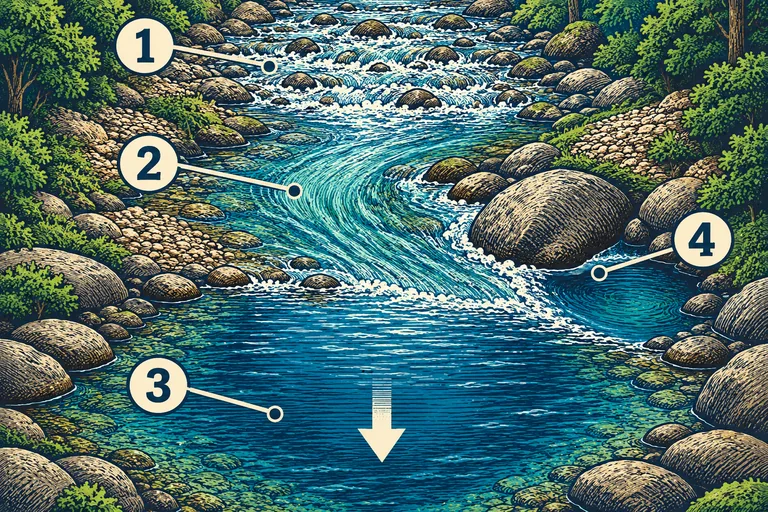
- 1 · Riffle
- A broken, choppy surface over shallow structure. Look for adjacent pockets and transitions rather than treating every patch of fast water alike.
- 2 · Run
- A more continuous stretch of flow. Look along changes in speed and beside cover.
- 3 · Pool
- A deeper or slower section. Inspect its entrance, edges and exit, as well as cover within it.
- 4 · Sheltered pocket and seam
- The calmer pocket downstream of the boulder is marked 4. Its boundary with the faster main flow is a current seam. Such shelter beside passing food is a candidate to investigate, not a confirmed fishing spot.
Sources: NYDEC: where to fish in rivers and streams (opens in a new tab)
Make the first casts count
Approach quietly and avoid putting your shadow across the place you plan to fish. Cast from a stable bank where possible. In clear trout water, working upstream can help you approach fish facing into the flow, but bank access and casting obstacles may require a different angle.
Start within comfortable reach. Watch the lure, then vary the angle or retrieve before moving on. Check behind you before casting.
Choose rod length for the casting room and line control, and the rod’s rating for the actual rig. A creek does not always call for an ultralight.
Sources: NYDEC: fishing for stream trout (opens in a new tab)
Choose the fish, then the presentation
Confirm the local species first. A cold trout stream and a warm smallmouth creek need different decisions. There is no single lure-weight range that fits both every creek and every rod.
Trout on spinning gear
Where artificial lures are permitted, try a small spinner or spoon with a controlled retrieve. Adjust angle and speed so it works in the available depth without repeatedly snagging. Follow the lure maker’s rigging instructions.
Smallmouth in warmwater creeks
Missouri’s agency recommends presentations resembling local prey, including plastics, crankbaits and spinnerbaits. Try rock cover; experiment with lure type and retrieve speed. These are regional examples, not proof of smallmouth in your creek.
Use the Matcher’s exact product and setup instructions for the selected presentation. Check the rod’s printed lure rating against the whole cast load, including the lure or sinker, bait and hardware. A sinker’s weight alone is not a verified rig total.
Sources: NYDEC: fishing for stream trout (opens in a new tab) · Missouri conservation: smallmouth bass fishing (opens in a new tab)
Adjust to what you observe
Low, clear water: reduce disturbance and watch how the presentation moves before changing tackle. A careful approach may matter more than another product.
Cold trout water: Oregon’s winter fly-fishing advice highlights slower pockets and presentations close to fish. That is a regional trout example; it does not mean all fish stop chasing lures whenever water is cold.
Warm trout water: check agency advisories and any temperature-based closures. NYDEC cautions about warm downstream reaches on the Neversink. Measure the actual reach when relevant; an air-temperature estimate is not a water-temperature reading, and one river’s threshold is not a nationwide rule.
Rising or muddy water: reassess the trip before selecting heavier tackle. Floodwater is a reason to stay out, not a lure-selection challenge.
A nearby USGS gauge can provide context. Its stage is water height above that station’s reference datum; it is not the depth where you stand or a safe-to-wade score. Conditions can differ between the gauge and your access point.
Sources: ODFW: winter trout fishing in Oregon (opens in a new tab) · NYDEC: Neversink River trout fishing (opens in a new tab) · USGS: what gage height means (opens in a new tab) · National Weather Service: flood safety (opens in a new tab)
Stay on safe ground
- Calm-looking water can conceal current, cold temperatures and abrupt depth changes. Keep away from unstable banks and slippery edges.
- Avoid fallen-tree strainers, gaps between rocks and other places that can trap a person. Do not use this illustration to plan a crossing.
- Wear a properly fitted life jacket when fishing where falling into moving or deep water is a risk. Choose established bank access and turn back when the footing or exit is uncertain.
- Never walk or drive into floodwater. Leave promptly if water rises or weather deteriorates.
Sources: National Park Service: river and stream safety (opens in a new tab) · National Weather Service: flood safety (opens in a new tab)
Ready to choose gear?
Keep your chosen fish and set the Matcher to creek fishing. Refine the clarity and conditions there; the guide does not know your creek’s current conditions.