Fish guide
Bluegill
The fish most of us caught first, and still one of the most fun: bluegill live in ponds and lakes across most of the country, bite much of the day in summer, and pull hard for their size on light tackle.
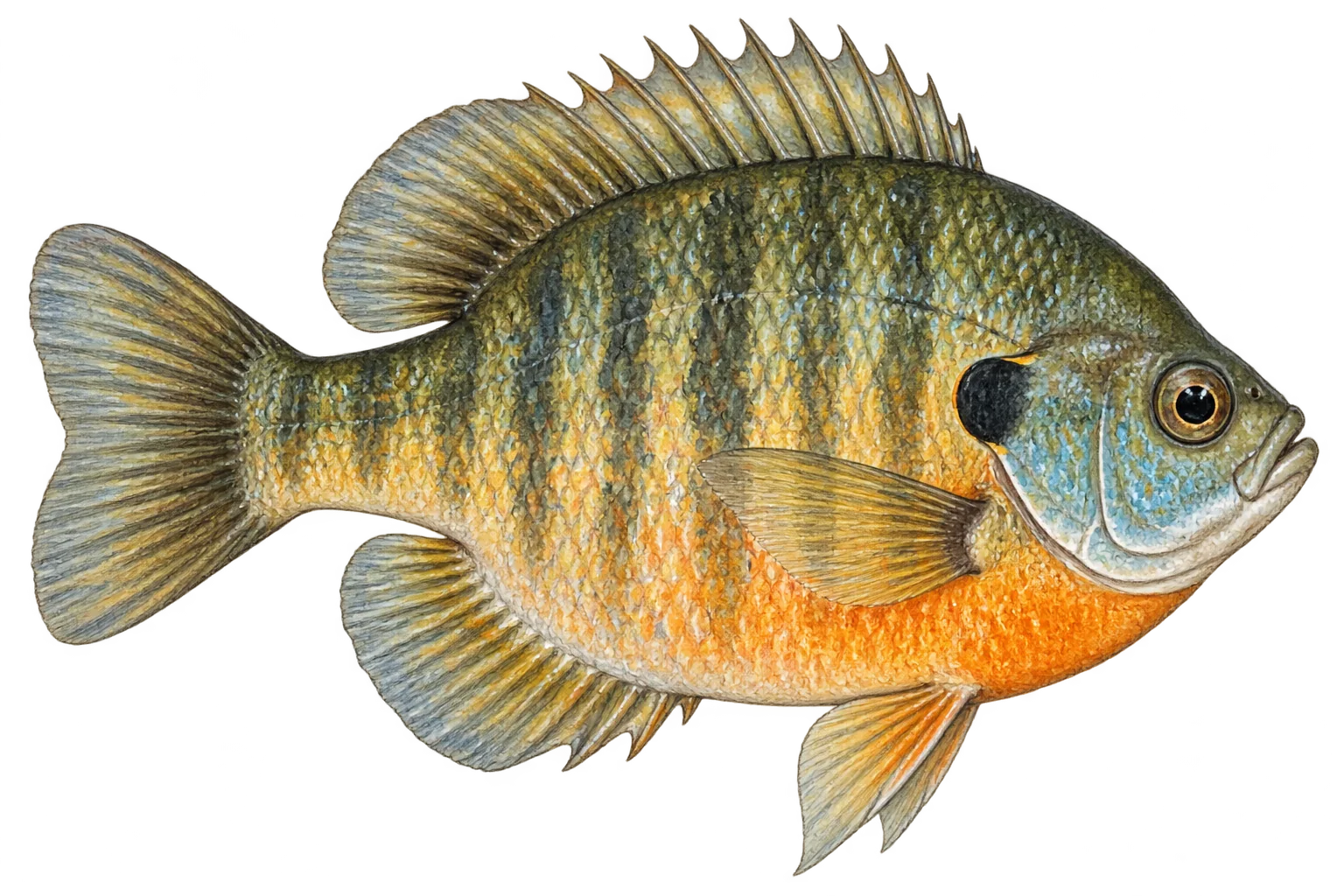
Lepomis macrochirus · also called bream, brim, sunny, copper nose
How to tell it
- A dark, solid black flap at the back of the gill cover (the “ear”), with no colored edge.
- A dark smudge at the back of the soft dorsal fin, and faint dark bars down a blue-green to olive side.
- A small mouth that stops well short of the eye; breeding males have a rusty orange breast.
Size: Most are 4–8 inches. A 9- or 10-inch “bull” bluegill of about a pound is a fine fish anywhere.
What to throw
The first pick and the backup for every water clarity and light, from the Gear Matcher. Tap one to see the whole kit.
Pond · Transition water (50–65°F)
Clear water · see 4 ft+ down
Stained water · 1–4 ft of sight
Murky water · under 1 ft
Rain fishes like a cloudy day, so it is left out. These are the everyday picks: in spring and fall the Gear Matcher adds the season’s patterns for some fish.
Our picks for these
- Piece of Nightcrawler under a Small Bobber: Smaky hooks and bobbers kit, 80 pack
- Tiny Jig: Crappie Magnet kit, 78 pieces
- Beetle Spin: Johnson Beetle Spin, 2 in, black/yellow
- Piece of Nightcrawler under a Lighted Bobber: QualyQualy lighted slip bobbers, 5 pack
- Tiny Jig near a Submersible Light: Linkstyle green underwater fishing light
Rod, reel and line
- Rod
- 4'8"–6' ultralight spinning
- Reel
- 500–1000 spinning
- Line
- 4 lb monofilament
Sunfish have small mouths and fight hard for their size. An ultralight rod with light line casts tiny baits and makes every fish fun.
Where and when
Pond fishing: plan your approach and read the water.
- Where they live
- Ponds, lakes and slow rivers with weeds, docks, lily pads and fallen trees. Small ones stay in the shallows; the big ones sit a little deeper on the weed edge.
- Water they like
- Most active from 65 to 80°F. They keep biting, slowly, in cold water and through the ice.
- Best time
- Much of the day in summer, best in the morning and evening. On the beds they often bite at any hour.
- Spawning
- From late spring into summer, at about 70°F, males fan out round beds packed side by side in 1–3 feet of water, often several times a season.
Through the year
Best months for bluegill: May–July.
- January: good.
- February: good.
- March: slower.
- April: good.
- May: best.
- June: best.
- July: best.
- August: good.
- September: good.
- October: slower.
- November: slower.
- December: slower.
Earlier in the South and later in the North. On the beds they often bite at any hour.
A general pattern, not a local forecast. Pick your state for a rough adjustment: bluegill follow the water’s warmth, earlier in the South and later in the North.
Spring
They move into warm, shallow bays as the water warms; a worm under a bobber near the first weeds is hard to beat.
Summer
On the beds early in the summer, then on weed edges, docks and shade. Small poppers on top at dawn and dusk.
Fall
They school up on the weed edges and feed before winter: small jigs and pieces of worm, a little deeper.
Winter
Slow and deeper, near weeds that are still green. One of the best fish to catch through the ice on tiny jigs.
Tips
- 1.Go small: a size 8–10 hook and a piece of worm fits a bluegill’s small mouth.
- 2.Set the bobber so the bait hangs just above the weeds or the bottom.
- 3.Find one and stay: bluegill often live in groups, and where there is one there are usually more.
The rules
Check local regulations. Many states have daily limits on sunfish. Redear (shellcrackers) eat snails: fish a worm right on the bottom for them.
Through the ice
What to drop
Tiny Tungsten Jig with a Wax Worm or Spike
or Micro Plastic on a Tiny Jig
- Rod
- 24"–28" ultralight ice rod
- Reel
- 500 spinning
- Line
- 2–4 lb monofilament or fluorocarbon
How thick the ice must be
- Under 4"Stay off
- 4"Ice fishing and anything on foot
- 5–7"Snowmobile or ATV
- 8–12"Car or small pickup
- 12–15"Medium truck
For new, clear ice. White or snowy ice is about half as strong, so double these. Check it with a spud bar or auger as you go out, and keep off ice over moving water, near inlets and at pressure ridges. No ice is completely safe.