Fish guide
Largemouth bass
One of America’s most popular game fish, found in nearly every state in ponds, lakes, reservoirs and slow rivers. Largemouth ambush their food from cover, so much of the game is working out which cover they are in today.
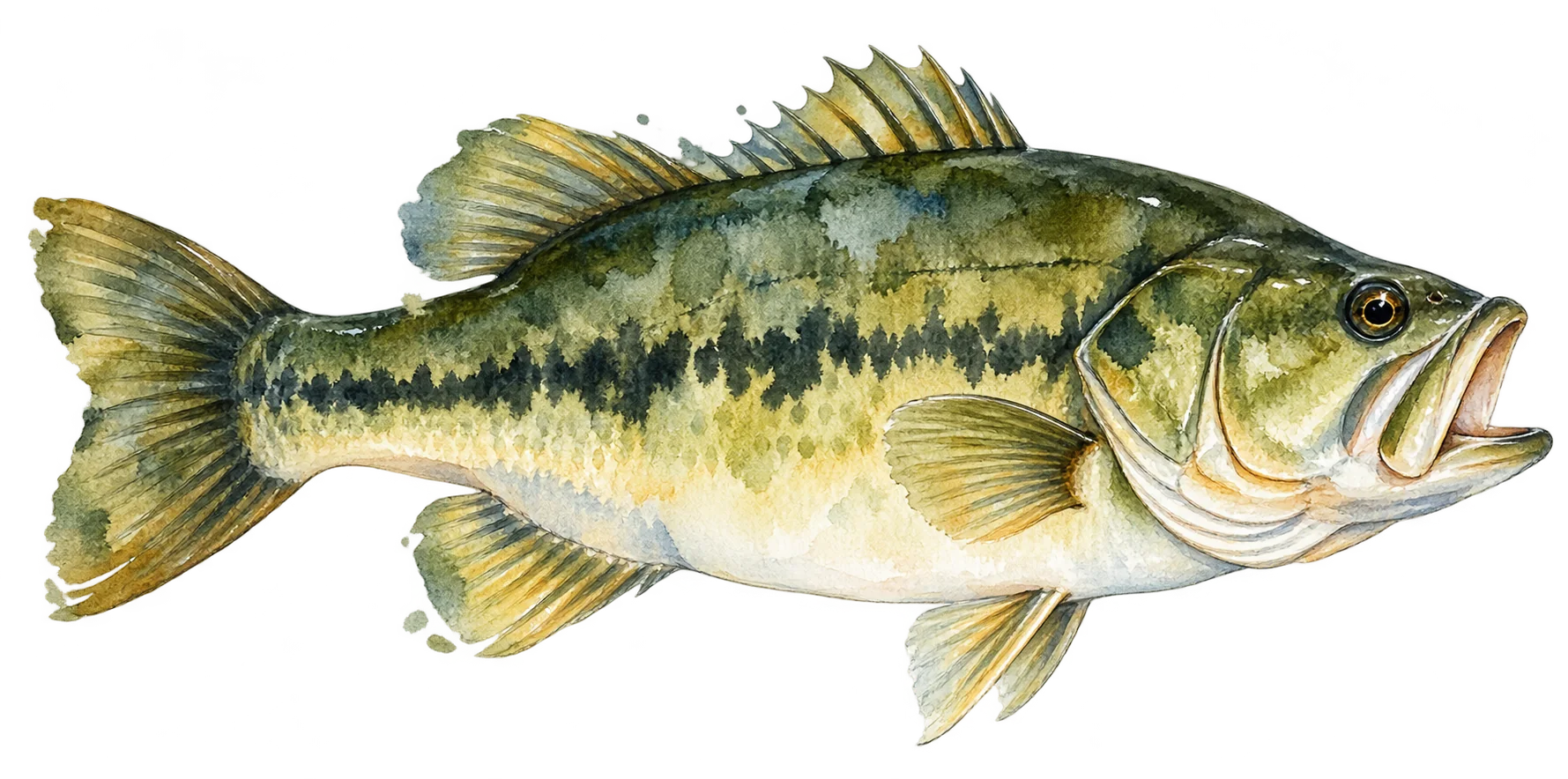
Micropterus nigricans (until 2024 part of M. salmoides, a name now used for Florida bass) · also called bucketmouth, green bass, black bass
How to tell it
- The upper jaw reaches past the back of the eye (on a smallmouth it stops below the eye).
- A dark, ragged stripe along the side of a green to olive body, with a white belly.
- The spiny and soft parts of the dorsal fin are almost separate, with a deep notch between them.
Size: Most are 1–3 lb and 12–18 inches. A 5-pound bass is a trophy in the North; Florida-strain bass in Florida, Texas and California grow past 10 pounds.
What to throw
The first pick and the backup for every water clarity and light, from the Gear Matcher. Tap one to see the whole kit.
Lake · Transition water (50–65°F)
Clear water · see 4 ft+ down
Stained water · 1–4 ft of sight
Murky water · under 1 ft
Rain fishes like a cloudy day, so it is left out. These are the everyday picks: in spring and fall the Gear Matcher adds the season’s patterns for some fish.
Our picks for these
- Ned Rig or Senko: Z-Man Ned Rig Kit, green pumpkin
- Drop Shot Rig: Roboworm Straight Tail Worm, 4.5 in, Aaron's Magic
- Suspending Jerkbait: Rapala X-Rap XR10, silver
- Senko: Yamamoto Senko, 5 in, green pumpkin
- Black Spinnerbait (Colorado blade): BOOYAH Moon Talker, black/blue
- Black / Blue Jig: Strike King Tour Grade skipping jig, 3/8 oz, black/blue
- Spinnerbait: BOOYAH Blade Double Willow, white/chartreuse
- Squarebill Crankbait: Strike King KVD 1.5 squarebill, 3/8 oz, natural bream
- Bladed Jig (ChatterBait): Z-Man Original ChatterBait, 3/8 oz, chartreuse sexy shad
- Bladed Jig (ChatterBait): Z-Man Original ChatterBait, 3/8 oz, black/blue
- Texas-Rigged Creature Bait: Yamamoto Kreature, 4 in, black with blue flake, 7 pack
Rod, reel and line
- Rod
- 7' medium-heavy casting
- Reel
- Baitcasting, 6.4–7.1:1
- Line
- 12–15 lb fluorocarbon
A medium-heavy rod has the backbone to pull bass out of cover, and fluorocarbon is hard for them to see.
For finesse baits (Ned rigs, Senkos, drop shots)
- Rod
- 7' medium spinning
- Reel
- 2500 spinning
- Line
- 8 lb fluorocarbon
Ned rigs, Senkos and drop shots are light baits. A spinning rod casts them easily and light line helps them fall naturally.
For frogs in heavy cover
- Rod
- 7'3"–7'6" heavy casting
- Reel
- Baitcasting, 7.1–8.1:1
- Line
- 50–65 lb braid
Frogs are fished in the thickest cover. A heavy rod and braid that does not stretch drive the hook home and pull the bass out of the weeds.
Where and when
Lake fishing: plan your approach and read the water.
- Where they live
- Warm, still or slow water with cover: weeds, lily pads, fallen trees, docks and brush. They hold tight to it and wait for food to come past.
- Water they like
- Most active from 65 to 80°F. They slow down below 50°F, but still take a slow bait.
- Best time
- Dawn and dusk, and cloudy days. In summer, night can be best of all.
- Spawning
- In spring, when the water reaches about 60–65°F, males fan out nests in 2–6 feet of water and guard the eggs and fry. Many states protect them on their beds.
Through the year
Best months for largemouth bass: March–May and October.
- January: slower.
- February: good.
- March: best.
- April: best.
- May: best.
- June: good.
- July: slower.
- August: slower.
- September: good.
- October: best.
- November: good.
- December: slower.
Earlier in the South and later in the North. In summer, fish dawn, dusk and night; in winter, fish slowly and deep.
A general pattern, not a local forecast. Pick your state for a rough adjustment: largemouth bass follow the water’s warmth, earlier in the South and later in the North.
Spring
Before the spawn they wait on points and drop-offs near the spawning flats, then move shallow. Slow soft plastics and jigs catch them around the beds.
Summer
Shallow early and late; in the midday heat they move to thick cover, shade or deeper water. Topwater at dawn, then a Texas rig or a jig in the shade.
Fall
They chase baitfish into the backs of creeks and coves and feed hard before winter: lipless crankbaits, spinnerbaits and swimbaits.
Winter
Grouped up on deep structure and slow to bite: a jig, a jerkbait paused for long seconds, or a drop shot.
Tips
- 1.Start with the cover: a lure that bumps a stump or ticks a weed gets bit. When they roam open water after baitfish, follow the bait.
- 2.When they stop chasing, slow down and drag a soft plastic or a jig.
- 3.Check your line after every fish: bass in cover fray it fast.
The rules
Spawning season: many states close bass, walleye or pike fishing, or make it catch-and-release, until an opener. Leave fish on their beds alone. Check local regulations.
Through the ice
What to drop
Jigging Spoon
or Live Minnow under a Tip-Up
- Rod
- 28"–30" medium-light ice rod
- Reel
- 500–1000 spinning
- Line
- 6 lb fluorocarbon
How thick the ice must be
- Under 4"Stay off
- 4"Ice fishing and anything on foot
- 5–7"Snowmobile or ATV
- 8–12"Car or small pickup
- 12–15"Medium truck
For new, clear ice. White or snowy ice is about half as strong, so double these. Check it with a spud bar or auger as you go out, and keep off ice over moving water, near inlets and at pressure ridges. No ice is completely safe.