Fish guide
Lake trout
A char (not a true trout) of deep, cold northern lakes that grows big and lives long: lake trout come shallow in spring and fall, and the rest of the year you go deep to find them.
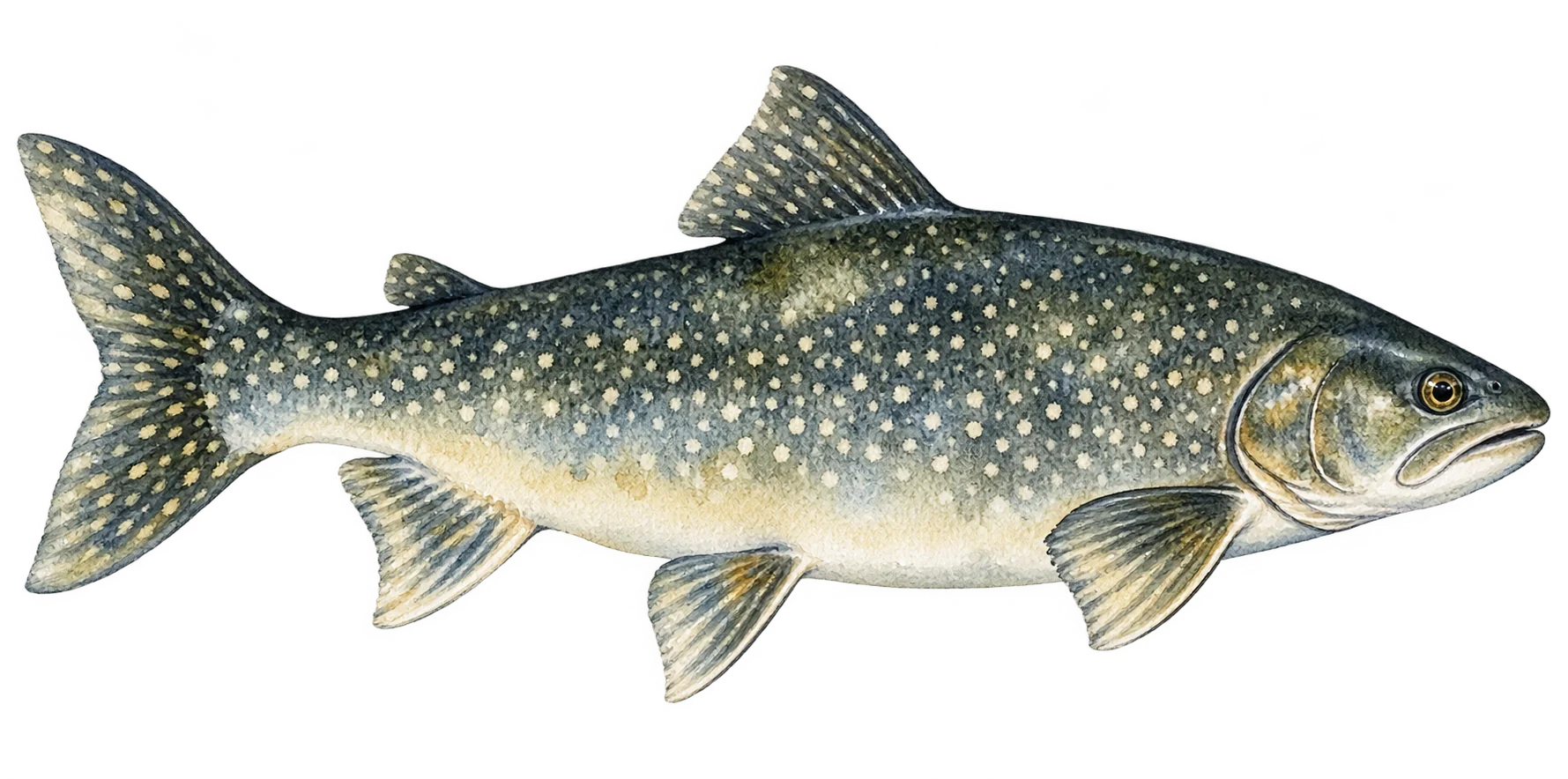
Salvelinus namaycush · also called laker, mackinaw, togue, gray trout
How to tell it
- Pale, cream-colored spots all over a dark gray to green-gray body, the head and fins too.
- A deeply forked tail (a brook trout’s is nearly square).
- A white leading edge on the lower fins.
Size: Most are 3–10 lb and 20–30 inches. Fish of 20 lb and more live in big northern lakes, and the biggest top 50 lb.
What to throw
The first pick and the backup for every water clarity and light, from the Gear Matcher. Tap one to see the whole kit.
Lake · Transition water (50–65°F)
Clear water · see 4 ft+ down
Stained water · 1–4 ft of sight
Murky water · under 1 ft
Rain fishes like a cloudy day, so it is left out. These are the everyday picks: in spring and fall the Gear Matcher adds the season’s patterns for some fish.
Our picks for these
- Large Jigging Spoon: Strike King Sexy Spoon, 5.5 in, sexy shad
- Tube Jig: Northland Predator tube jig, 3/4 oz, white, 2 pack
- Glow Jigging Spoon: TRUSCEND glow jigging spoons, 1.4 oz, 3.4 in
- Blade Bait: Heddon Sonar blade bait, 2 3/8 in, chrome
Rod, reel and line
- Rod
- 7'–8' medium-heavy spinning or casting
- Reel
- 3000 spinning
- Line
- 15–20 lb braid
- Leader
- 12–15 lb fluorocarbon leader
Lake trout live deep. Braid lets you feel a bite and set the hook 80 feet down, and the fluorocarbon leader keeps it out of sight.
Where and when
Lake fishing: plan your approach and read the water.
- Where they live
- Deep, cold, clear lakes with plenty of oxygen: the Great Lakes, and big lakes across the north and in the Rockies. In summer they are often 40–100 feet down, following cold water and baitfish.
- Water they like
- Cold water only: they like about 45–55°F, and follow that temperature down as the lake warms.
- Best time
- Early morning and evening when they come shallow; in summer they bite at depth through the day.
- Spawning
- In fall, as the water cools to about 50°F, over rocky reefs and shoals, often at night.
Through the year
Best months for lake trout: January–February and May.
- January: best.
- February: best.
- March: good.
- April: slower.
- May: best.
- June: good.
- July: slower.
- August: slower.
- September: good.
- October: slower.
- November: slower.
- December: good.
Ice-out comes later the farther north you go. Some waters close in fall for the spawn: check yours.
A general pattern, not a local forecast. Ice, runs, stocking and the rules set the season for lake trout, water by water.
Spring
Shallow right after ice-out, along shorelines and reefs: cast spoons and jerkbaits, or troll near the surface.
Summer
Deep in the cold water, near the bottom or suspended with the baitfish: jig tubes and big spoons, or troll deep.
Fall
They come up onto rocky reefs to spawn: shallow again, but check the season (some waters close).
Winter
A top ice fish: jig a tube or a big spoon near the bottom, and reel it up fast when one follows.
Tips
- 1.Get down to them: in summer, fish the depth of the cold water and the baitfish, near the bottom or suspended.
- 2.Watch a fish finder: a lake trout often follows a lure up before it hits.
- 3.Bring them up slowly and steadily, and release them quickly: big lakers are decades old. Some waters require you to keep lake trout: check the rules.
The rules
Check local regulations. Most lakes have size and bag limits.
Through the ice
What to drop
Tube Jig
or Large Jigging Spoon or Blade Bait
- Rod
- 32"–36" medium ice rod
- Reel
- 1000–2500 spinning
- Line
- 10 lb braid with a 10 lb fluorocarbon leader
How thick the ice must be
- Under 4"Stay off
- 4"Ice fishing and anything on foot
- 5–7"Snowmobile or ATV
- 8–12"Car or small pickup
- 12–15"Medium truck
For new, clear ice. White or snowy ice is about half as strong, so double these. Check it with a spud bar or auger as you go out, and keep off ice over moving water, near inlets and at pressure ridges. No ice is completely safe.