Fish guide
Crappie
Schooling panfish of lakes, reservoirs and slow rivers all over the country, and among the best to eat. Find one and you have often found a school.
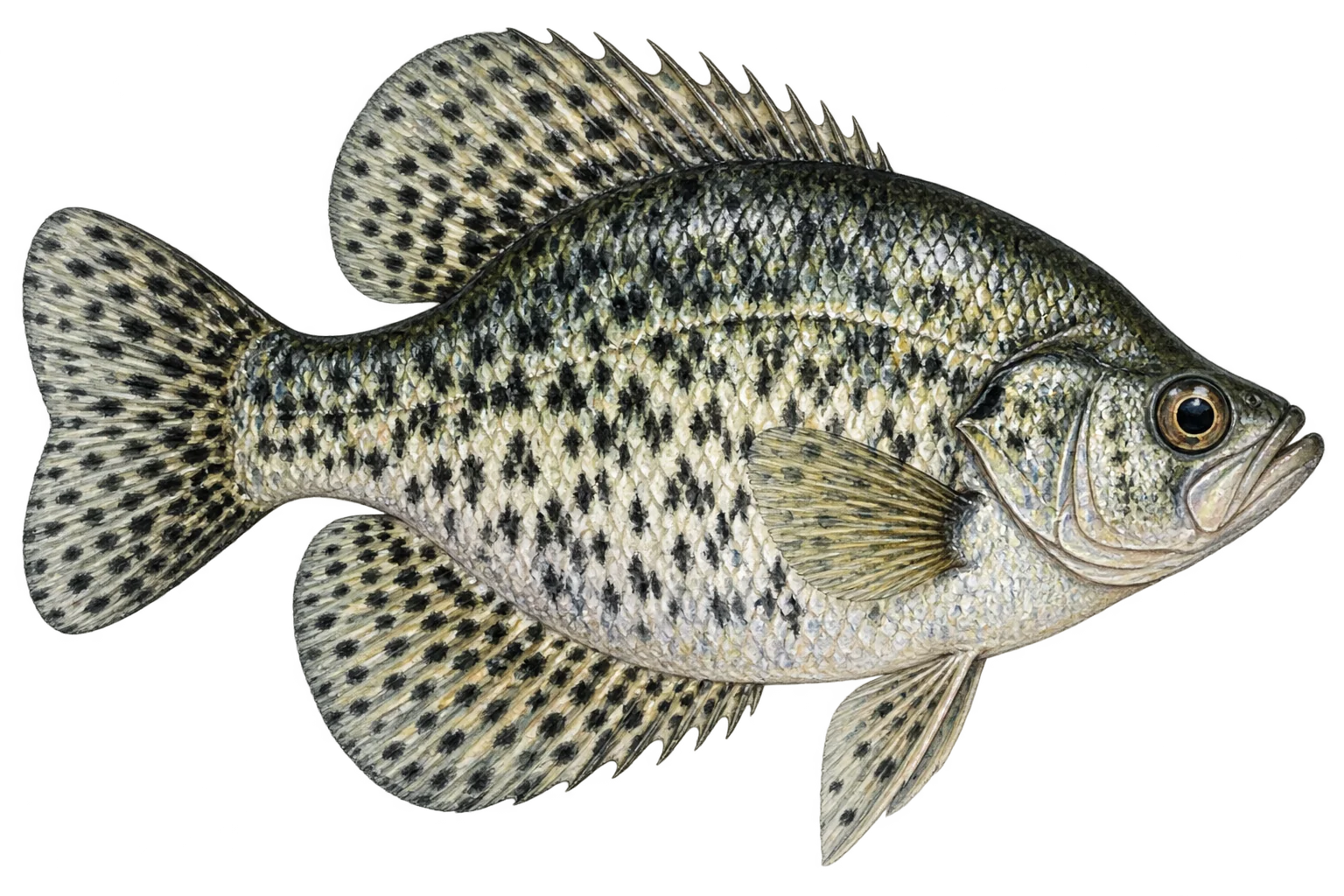
This guide covers black and white crappie, two species: Pomoxis nigromaculatus, Pomoxis annularis · also called papermouth, speck, sac-a-lait, slab
How to tell it
- A deep, flat, silver body with black speckles (black crappie) or faint vertical bars (white crappie).
- A big mouth with a thin, papery edge: set the hook gently.
- Large dorsal and anal fins of almost the same size; black crappie have 7–8 dorsal spines, white crappie 5–6.
Size: Most are 8–12 inches; a “slab” of 14 inches or 2 pounds is a fine catch.
What to throw
The first pick and the backup for every water clarity and light, from the Gear Matcher. Tap one to see the whole kit.
Lake · Transition water (50–65°F)
Clear water · see 4 ft+ down
Stained water · 1–4 ft of sight
Murky water · under 1 ft
Rain fishes like a cloudy day, so it is left out. These are the everyday picks: in spring and fall the Gear Matcher adds the season’s patterns for some fish.
Our picks for these
- Small Jig: Z-Man Shad FryZ 1.75", Smelt, 8 pack
- Worm or Live Minnow under a Bobber: Eagle Claw 202EL gold Aberdeen, #4
- Small Jig or Minnow near a Submersible Light: Linkstyle green underwater fishing light
- Minnow under a Lighted Bobber: QualyQualy lighted slip bobbers, 5 pack
- Small Jig: Z-Man Shad FryZ 1.75", Firetreuse, 8 pack
Rod, reel and line
- Rod
- 5'6"–7' ultralight spinning
- Reel
- 1000 spinning
- Line
- 4–6 lb monofilament
Light line and a soft rod let you cast tiny jigs and feel small fish.
Where and when
Lake fishing: plan your approach and read the water.
- Where they live
- Standing timber, brush piles, docks, bridge pilings and weed edges, often suspended halfway down.
- Water they like
- Most active from 55 to 75°F.
- Best time
- Dawn and dusk, and under lights at night from docks and bridges.
- Spawning
- Spring, in shallow brush and weeds: black crappie at around 60°F, white crappie usually a little warmer, often the mid 60s (in the South, about when the redbuds bloom).
Through the year
Best months for crappie: March–May.
- January: good.
- February: good.
- March: best.
- April: best.
- May: best.
- June: good.
- July: slower.
- August: slower.
- September: slower.
- October: good.
- November: good.
- December: slower.
Earlier in the South (about when the redbuds bloom) and later in the North. In summer, fish deep brush, or under lights at night.
A general pattern, not a local forecast. Pick your state for a rough adjustment: crappie follow the water’s warmth, earlier in the South and later in the North.
Spring
They crowd into the shallows to spawn: small jigs under a bobber around brush and docks.
Summer
Deeper brush piles and timber, suspended: minnows and jigs fished at their depth.
Fall
They follow the baitfish into creek arms: jigs and minnows around cover.
Winter
Suspended over deep basins and channels, and under the ice: tiny jigs and minnows.
Tips
- 1.Find their depth: count your jig down and remember the count when you get bit.
- 2.A light touch: their mouths tear easily.
- 3.Where you catch one, keep fishing: they often school.
The rules
Seasons, size and bag limits for this fish differ from state to state, and from water to water. Check local regulations.
Through the ice
What to drop
Tiny Tungsten Jig with a Wax Worm or Plastic
or Small Minnow under a Slip Bobber
- Rod
- 24"–28" ultralight ice rod
- Reel
- 500 spinning
- Line
- 2–4 lb monofilament or fluorocarbon
How thick the ice must be
- Under 4"Stay off
- 4"Ice fishing and anything on foot
- 5–7"Snowmobile or ATV
- 8–12"Car or small pickup
- 12–15"Medium truck
For new, clear ice. White or snowy ice is about half as strong, so double these. Check it with a spud bar or auger as you go out, and keep off ice over moving water, near inlets and at pressure ridges. No ice is completely safe.