Fish guide
Catfish
Found across most of the country, in rivers, lakes and ponds, and caught by smell more than sight: bait on the bottom is how most catfish are caught, by day or by night.
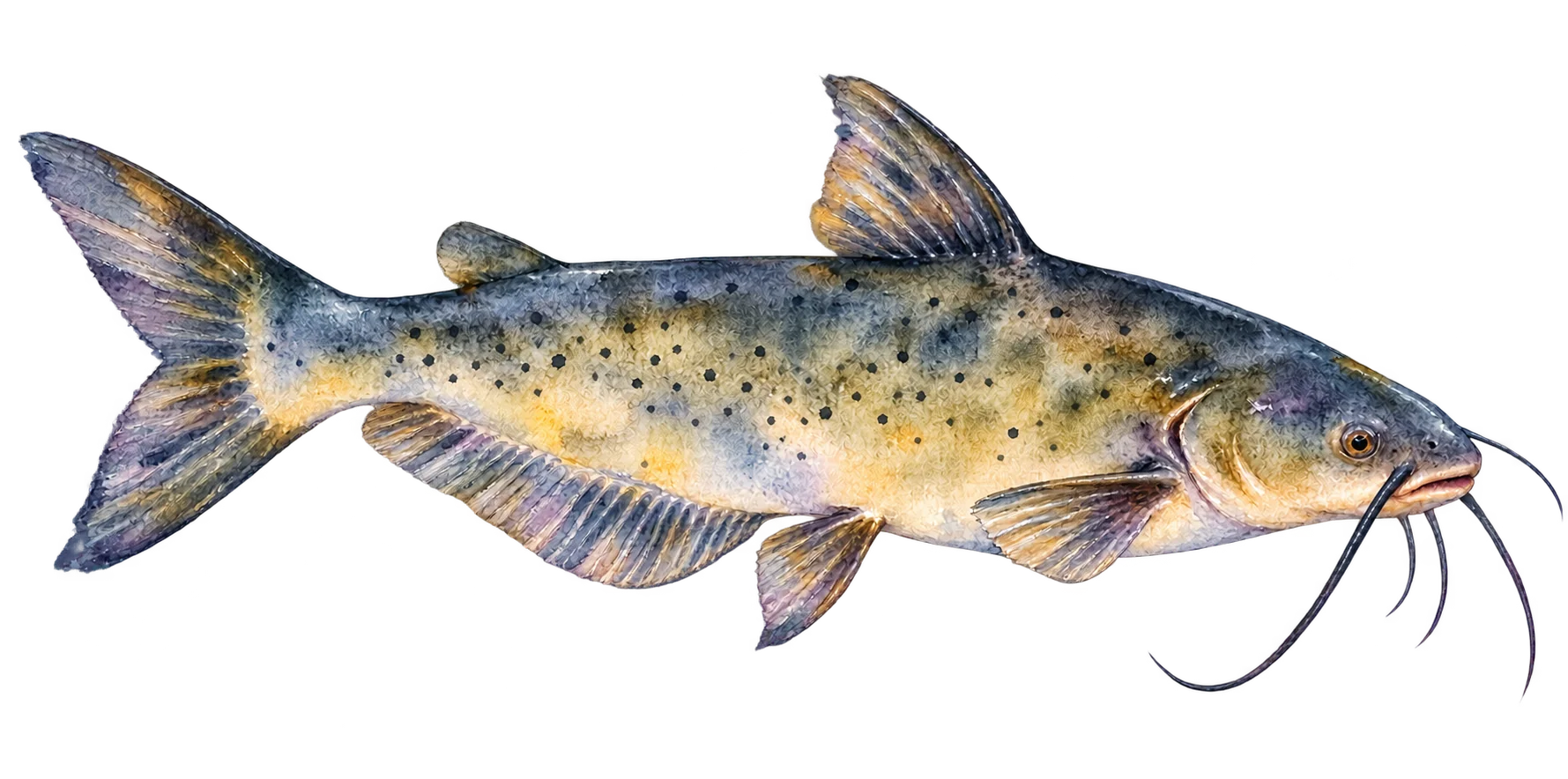
This guide covers channel, blue and flathead catfish, three species: Ictalurus punctatus, Ictalurus furcatus, Pylodictis olivaris · also called cat, whiskerfish, fiddler (a small channel cat), mudcat (a flathead)
How to tell it
- No scales, and long whiskers (barbels) around the mouth.
- Channel catfish: slate blue-grey, often with small dark spots (big ones can lose them), and a deeply forked tail.
- Blue catfish have a long, straight-edged anal fin (30 rays or more; a channel cat has fewer) and no spots; flatheads a flat head, a square tail and a jutting lower jaw.
Size: Channel cats are often 2–10 lb; blues and flatheads grow far bigger, past 50 pounds in big rivers.
What to throw
The first pick and the backup for every water clarity and light, from the Gear Matcher. Tap one to see the whole kit.
River · Transition water (50–65°F)
Clear water · see 4 ft+ down
Stained water · 1–4 ft of sight
Murky water · under 1 ft
Rain fishes like a cloudy day, so it is left out. These are the everyday picks: in spring and fall the Gear Matcher adds the season’s patterns for some fish.
Our picks for these
- Scent Bait on a Sliding-Sinker Rig: Gamakatsu Octopus Circle Inline Point, 3/0, NS Black
Rod, reel and line
- Rod
- 7' medium-heavy
- Reel
- 4000 spinning or baitcasting
- Line
- 15–20 lb monofilament (12–15 lb in ponds)
A stout rod and strong mono handle heavy sinkers and big fish, and mono stretches enough to keep circle hooks from pulling.
Where and when
River fishing: plan your approach and read the water.
- Where they live
- River channels, deep holes, outside bends and the water below dams, and the bottoms of lakes and ponds near cover.
- Water they like
- Most active from 70 to 85°F: they feed in warmer water than most fish.
- Best time
- Night, dusk and dawn, and any time the water is muddy and rising.
- Spawning
- Early summer, at about 75–80°F, in hollow logs, undercut banks and crevices; the males guard the nest.
Through the year
Best months for catfish: May–August.
- January: slower.
- February: slower.
- March: slower.
- April: good.
- May: best.
- June: best.
- July: best.
- August: best.
- September: good.
- October: good.
- November: slower.
- December: slower.
Best in warm water and at night. Rising, muddy water after a spring rain can be the best day of the year. Big blue catfish are the exception: winter is a top time for them on big Southern reservoirs.
A general pattern, not a local forecast. Pick your state for a rough adjustment: catfish follow the water’s warmth, earlier in the South and later in the North.
Spring
Rising, muddy water after rain is prime: cut bait and worms on the edges of the current.
Summer
Night fishing at its best: stink bait, chicken liver and cut bait on the bottom for channel cats, and live fish for big flatheads.
Fall
Feeding up before winter: cut shad near drop-offs.
Winter
Deep holes, and slow: cut bait, fished patiently.
Tips
- 1.Use a circle hook and let the fish take it: tighten the line, don’t jerk.
- 2.Fresh cut bait from the same water beats anything from a jar for blues.
- 3.Mind the spines on the dorsal and side fins: they sting.
The rules
Seasons, size and bag limits for this fish differ from state to state, and from water to water. Check local regulations.
Through the ice
What to drop
Cut Bait or a Dead Minnow on the Bottom
or Nightcrawler on the Bottom
- Rod
- 30"–36" medium ice rod
- Reel
- 2500 spinning
- Line
- 10–12 lb monofilament
How thick the ice must be
- Under 4"Stay off
- 4"Ice fishing and anything on foot
- 5–7"Snowmobile or ATV
- 8–12"Car or small pickup
- 12–15"Medium truck
For new, clear ice. White or snowy ice is about half as strong, so double these. Check it with a spud bar or auger as you go out, and keep off ice over moving water, near inlets and at pressure ridges. No ice is completely safe.