Fish guide
White bass
A fast, hard-fighting cousin of the striper that hunts shad in schools: when white bass break the surface, the action can be fast.
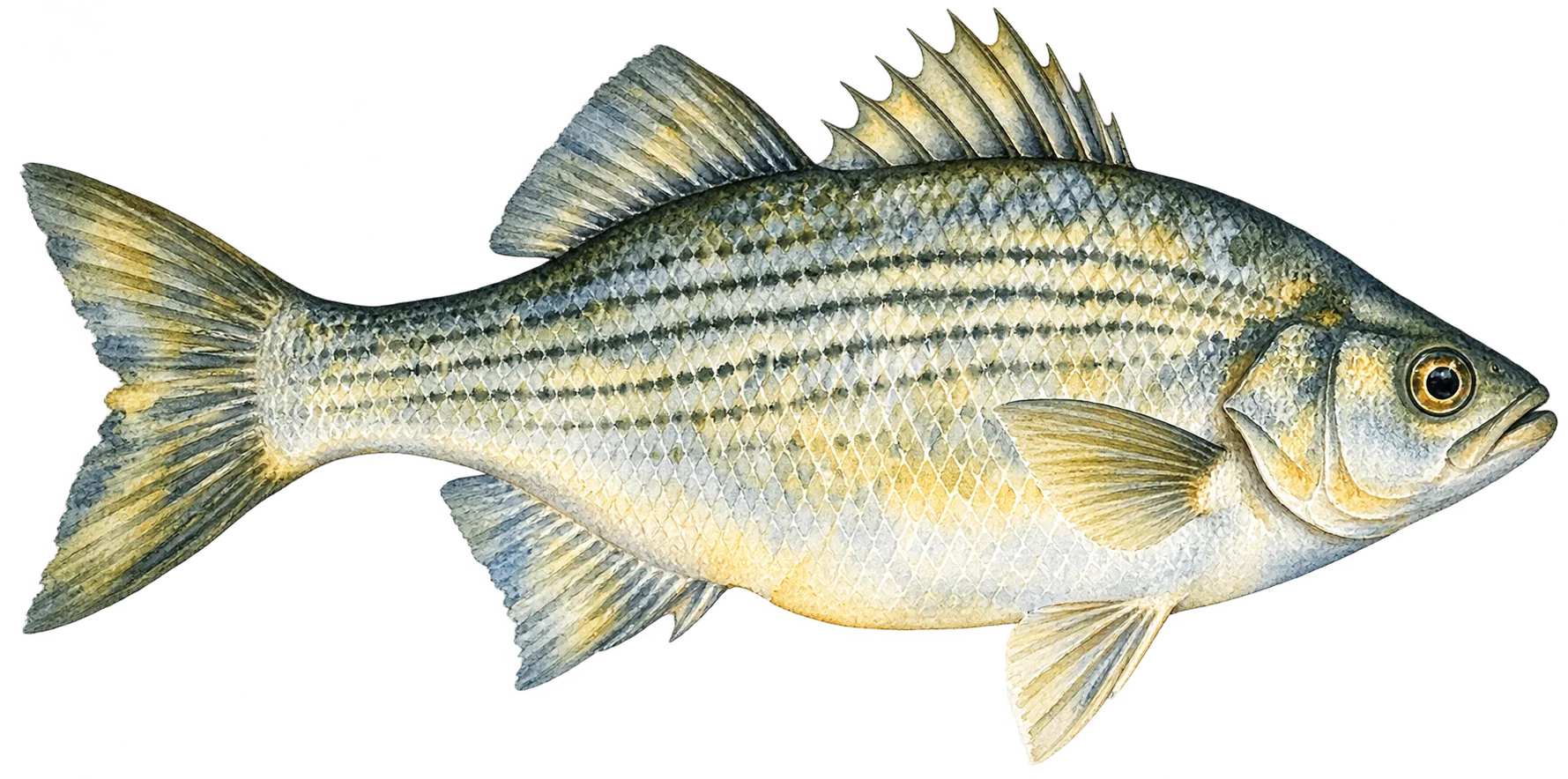
Morone chrysops · also called sand bass, silver bass, stripe
How to tell it
- Silver to white, with thin dark lines along the side, the lines fainter and more broken than a striper’s.
- A deep, compressed body that rises steeply behind the head.
- Usually one tooth patch on the tongue (a hybrid usually has two, sometimes touching), and the lower jaw sticks out: check more than one sign.
Size: Most are 10–14 inches and about a pound; a 3-pound white bass is a big one.
What to throw
The first pick and the backup for every water clarity and light, from the Gear Matcher. Tap one to see the whole kit.
Lake · Transition water (50–65°F)
Clear water · see 4 ft+ down
Stained water · 1–4 ft of sight
Murky water · under 1 ft
Rain fishes like a cloudy day, so it is left out. These are the everyday picks: in spring and fall the Gear Matcher adds the season’s patterns for some fish.
Our picks for these
- Slab Spoon: Cotton Cordell C.C. Spoon, 1/2 oz, silver
- Small Inline Spinner: Worden's Rooster Tail, 1/4 oz, flash white
- Small Topwater Walking Bait: Heddon Zara Puppy, 3 in, 1/4 oz, black shiner
- Small Jig or Minnow near a Submersible Light: Linkstyle green underwater fishing light
- Live Minnow under a Lighted Bobber: QualyQualy lighted slip bobbers, 5 pack
- Curly-Tail Grub on a Jig Head: OROOTL grubs and jig heads kit, 17 pack
- Lipless Crankbait: Strike King Red Eyed Shad, 1/2 oz, chrome blue
Rod, reel and line
- Rod
- 6'6"–7' medium-light spinning
- Reel
- 2500 spinning
- Line
- 8–10 lb braid or 8 lb monofilament
A medium-light rod casts small spinners and jigs far into a school and still handles a hybrid.
Where and when
Lake fishing: plan your approach and read the water.
- Where they live
- Big lakes, reservoirs and the rivers that feed them. They roam open water in schools chasing shad, and run up rivers in spring.
- Water they like
- Most active from 55 to 78°F; the spring run starts when the river reaches the mid 50s.
- Best time
- Early morning and evening when they push shad to the surface; windy points all day.
- Spawning
- In early spring they run up rivers and creeks to spawn over rock and gravel in the current, often in huge numbers.
Through the year
Best months for white bass: March–April and September–October.
- January: slower.
- February: slower.
- March: best.
- April: best.
- May: good.
- June: good.
- July: good.
- August: good.
- September: best.
- October: best.
- November: good.
- December: slower.
The run comes as early as February in Texas and in April or May in the North. In summer, watch for birds and splashes.
A general pattern, not a local forecast. Pick your state for a rough adjustment: white bass follow the water’s warmth, earlier in the South and later in the North.
Spring
The run: they pack into rivers and below dams. Small spinners, jigs and crankbaits in the current.
Summer
Out in the lake chasing shad: watch for splashes and birds and cast into them, or jig spoons on humps and points.
Fall
Schools chase shad on top again as the water cools: the best topwater bite of the year.
Winter
Deep and slower: jig slab spoons on the bottom where the shad are.
Tips
- 1.Carry a white or silver lure that casts far: when they break, you want to reach them.
- 2.Reel fast: white bass chase, and a fast lure looks like fleeing shad.
- 3.After the first fish, cast back to the same spot right away: the school is right there.
The rules
Hybrids (wipers) fight like small stripers; use the striped bass gear if you have it.
Through the ice
What to drop
Small Jigging Spoon
or Blade Bait
- Rod
- 28"–30" medium-light ice rod
- Reel
- 500–1000 spinning
- Line
- 6 lb fluorocarbon
How thick the ice must be
- Under 4"Stay off
- 4"Ice fishing and anything on foot
- 5–7"Snowmobile or ATV
- 8–12"Car or small pickup
- 12–15"Medium truck
For new, clear ice. White or snowy ice is about half as strong, so double these. Check it with a spud bar or auger as you go out, and keep off ice over moving water, near inlets and at pressure ridges. No ice is completely safe.