Fish guide
Muskellunge
The largest of the pike family, and famously hard to catch: muskie often follow a lure without eating it, and the one that does may be four feet long.
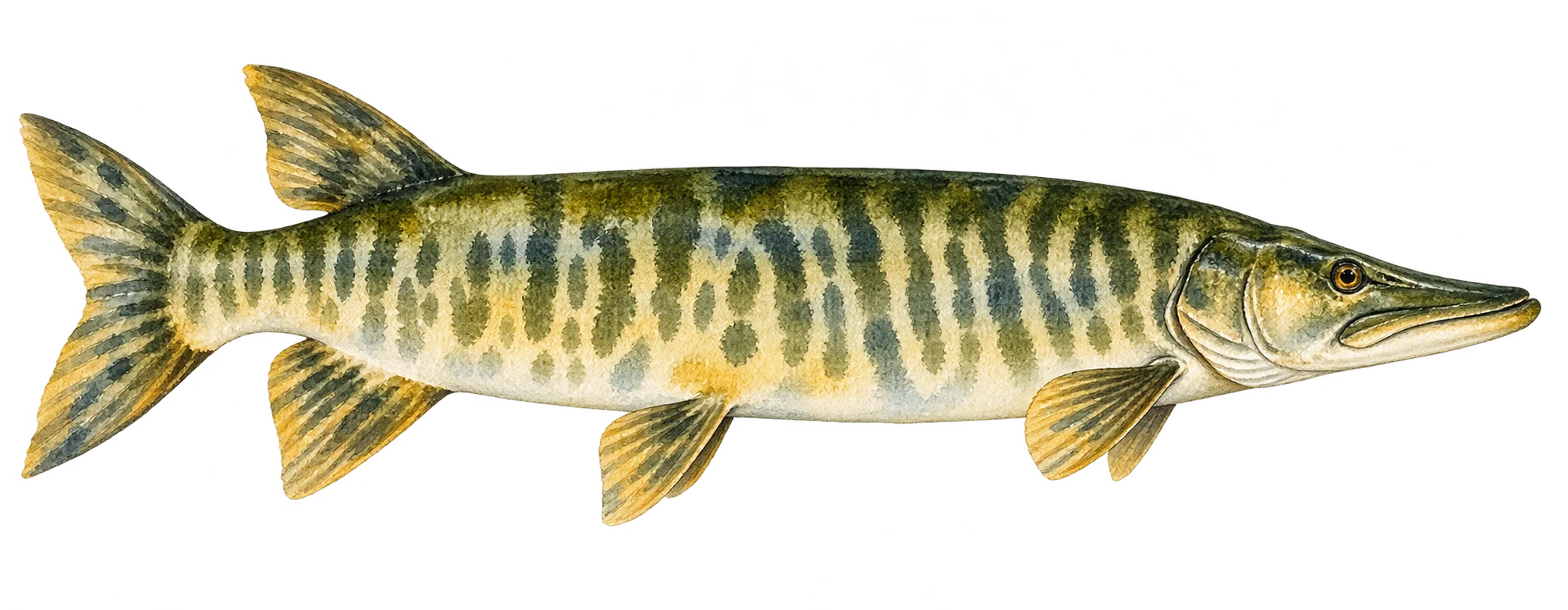
Esox masquinongy · also called musky, muskellunge, lunge, fish of 10,000 casts
How to tell it
- Dark bars or spots on a light green, silver or bronze side (a pike is the other way around: light spots on a dark side). A tiger muskie, the pike–muskie hybrid, has wavy, broken bars.
- Six to nine pores under each side of the lower jaw (a pike has five or fewer).
- Pointed tips on the lobes of the tail (a pike’s are rounded).
Size: Legal minimum sizes vary a lot by state and water (Minnesota’s statewide minimum is 54 inches): check yours. Fish of 40–50 inches and 20–40 lb are the ones people chase; the biggest top 50 lb.
What to throw
The first pick and the backup for every water clarity and light, from the Gear Matcher. Tap one to see the whole kit.
Lake · Transition water (50–65°F)
Clear water · see 4 ft+ down
Stained water · 1–4 ft of sight
Murky water · under 1 ft
Rain fishes like a cloudy day, so it is left out. These are the everyday picks: in spring and fall the Gear Matcher adds the season’s patterns for some fish.
Our picks for these
- Large Glide Bait or Jerkbait: Bassdash SwimShad glide bait, 7 in, white shad
- Large Bucktail Spinner: Mepps Musky Killer bucktail, 3/4 oz, hot orange
- Large Topwater: Musky Mania Doc topwater, 9 in, white
- Large Soft Swimbait: Berkley PowerBait CullShad, 8 in, sight flash
- Large Rubber Swimbait (Bulldawg style): MIZUGIWA pre-rigged musky swimbait, 8 in, 4 pack
Rod, reel and line
- Rod
- 8'–9' heavy muskie casting
- Reel
- Large baitcasting (300–400 size)
- Line
- 80–100 lb braid
- Leader
- Required: 80–130 lb fluorocarbon or heavy wire leader
Muskie are big, with sharp teeth, and lures for them are heavy. A long, heavy rod casts them all day and lands the fish quickly, so it can be released.
Where and when
Lake fishing: plan your approach and read the water.
- Where they live
- Clear, weedy northern lakes and big rivers. They hold on weed edges, rock bars and points, often alone, and roam open water following baitfish.
- Water they like
- Most active from 60 to 75°F. Very warm water (over 80°F) stresses them; many anglers stop then to protect the fish.
- Best time
- Dawn, dusk and low-light days, and the days around a front coming through. Fall is the best season.
- Spawning
- In spring, a little after pike, at about 50–60°F, in shallow weedy bays; they do not guard the eggs.
Through the year
Best months for muskellunge: September–November.
- January: slower.
- February: slower.
- March: slower.
- April: slower.
- May: slower.
- June: good.
- July: good.
- August: good.
- September: best.
- October: best.
- November: best.
- December: slower.
Many states keep the season closed until late May or June: check yours. Rest them in very hot water.
A general pattern, not a local forecast. Ice, runs, stocking and the rules set the season for muskellunge, water by water.
Spring
Slow at first after the spawn: smaller bucktails and jerkbaits in the warming bays (check that the season is open).
Summer
On weed edges and rock bars: big bucktails, topwater at dawn and dusk. Rest them in very hot water.
Fall
Prime time: the biggest muskie feed hard as the water cools. Big swimbaits and jerkbaits, and figure-eight every cast.
Winter
Rarely fished through the ice, and many states allow muskie fishing only in open water: wait for the season.
Tips
- 1.Finish every cast with a figure-eight at the boat or bank: many muskie strike there.
- 2.Bring the right tools: a big net, long pliers, jaw spreaders and heavy leaders.
- 3.Release them fast and keep them in the water: muskie are slow to grow and most are let go.
The rules
Specialist species. Many waters have size limits or catch-and-release only. Use a large net and long pliers. Check local regulations.
Through the ice
What to drop
Tip-Up with a Live Sucker
or Large Jigging Spoon
- Rod
- Tip-up, or a 36"–42" heavy ice rod
- Reel
- Tip-up spool, or 2500 spinning
- Line
- 30–50 lb braided tip-up line
- Leader
- Required: wire leader
How thick the ice must be
- Under 4"Stay off
- 4"Ice fishing and anything on foot
- 5–7"Snowmobile or ATV
- 8–12"Car or small pickup
- 12–15"Medium truck
For new, clear ice. White or snowy ice is about half as strong, so double these. Check it with a spud bar or auger as you go out, and keep off ice over moving water, near inlets and at pressure ridges. No ice is completely safe.