U.S. freshwater · Beginner guide
Fishing a lake
Choose one manageable area, plan for shore or boat, and let the fish and actual conditions guide the next decision.
Reviewed October 20, 2026 · Confirm species, access and current rules for your actual water.
Choose an area before a lure
A large lake or reservoir can offer more choices than a first trip needs. Start with one reachable section and a backup nearby, using the managing agency’s current access information.
Look for separate answers to separate questions: which fish are documented, where you can enter, what methods are allowed, and what a map says about the habitat. Texas Parks and Wildlife, for example, publishes lake information, reports, access resources and maps separately. One map pin cannot answer all of those questions.
Pick an area you can investigate and leave comfortably in the forecast conditions. A useful first outing can be a careful look at one cove or stretch of bank; you do not need to cover the whole lake.
Sources: Texas Parks and Wildlife: where to fish (opens in a new tab)
Plan for shore or boat
From shore
Choose an allowed bank or pier with room to cast and land a fish. Compare features within reach before assuming the middle of the lake is the answer. The pond guide’s bank-search method works as a practical way to organize those casts.
From a boat
Confirm the actual launch, craft and motor restrictions, forecast and return plan. Wear a suitable, correctly fitting USCG-approved life jacket. Keep the outing within the operator’s experience; being able to launch does not establish that the trip is suitable.
Monitor changing weather and return before deteriorating conditions cut off your options. A boat expands the water you can reach, but the bank-search lesson does not require one.
Sources: National Weather Service: inland boating (opens in a new tab) · U.S. Coast Guard: wearing a life jacket (opens in a new tab)
Read shape and cover together
Here, “shape” means the outline and bottom changes, while “cover” means objects such as plants, rocks or wood. Both can help organize a search; neither guarantees fish.
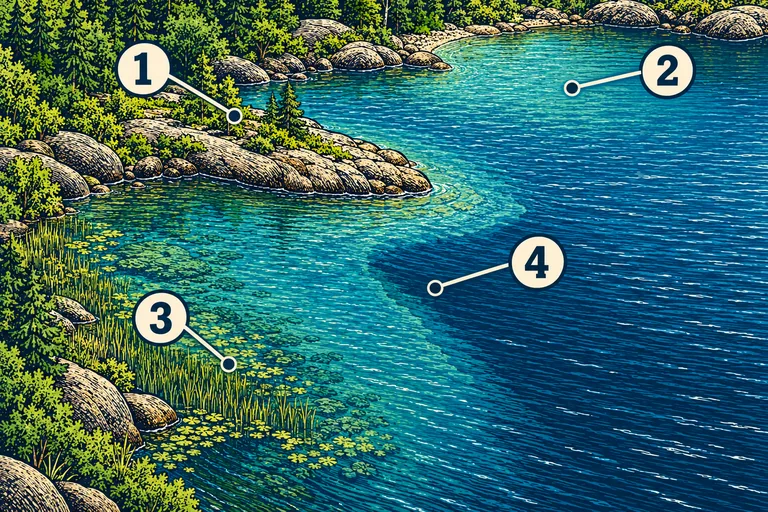
- 1 · Point
- Land projecting into the lake gives you an edge to investigate. Actual bottom shape may differ from the shoreline outline.
- 2 · Bay
- A recessed shoreline section offers a manageable area to compare. Shelter depends on wind and the actual site.
- 3 · Vegetation edge
- Try openings and adjacent water with a presentation that stays usable around plants.
- 4 · Depth transition
- Use a reliable contour map or appropriate observation to investigate changes. The illustration supplies no measured depth.
Sources: NYDEC: where to fish in lakes and ponds (opens in a new tab)
Choose one fish and method
Choose a fish documented in this lake and check its local rules. These options illustrate different presentations; a lake label alone does not determine rod power or lure weight.
Crappie
Try a small jig or permitted minnow presentation around suitable cover. Adjust the fishing depth to the actual feature and observations; keep the float and complete rig correctly loaded.
Largemouth bass
Investigate reachable vegetation or cover with a compatible soft-plastic presentation. Match the rig to the cover instead of using one exposed-hook lure everywhere.
Trout
A retrieved spinner or properly rigged permitted bait is a starting option where trout are documented. A floating-bait bottom rig depends on buoyant bait; ordinary worms do not automatically float.
Sources: NYDEC: fishing for crappie (opens in a new tab) · NYDEC: fishing for bass (opens in a new tab) · ODFW: how to fish for trout (opens in a new tab)
Treat depth as a question
The deepest water is not always the most usable habitat. USGS explains that dissolved oxygen can be low in deeper lake water, particularly where decaying material consumes it. Warm surface weather alone does not tell you where fish can live below.
Use species information, current reports and what you observe to choose your next presentation depth. Do not infer a thermocline, oxygen profile or fish location from this illustration, a season label or an air-temperature estimate.
Change one part of the presentation at a time: angle, retrieve or depth. Check the entire casting load against the rod’s printed range when changing tackle. Record the area, fish sought and what you tried; that gives the next trip a clear starting point.
Sources: USGS: dissolved oxygen and water (opens in a new tab)
Put the plan into practice
Keep your chosen fish and set the Matcher to lake fishing. Update the clarity and conditions yourself; this guide does not know the water’s current conditions.