Fish guide
Yellow perch
A schooling fish of northern lakes and the Great Lakes, and one of the best-tasting fish there is: find one yellow perch and you have found a school.
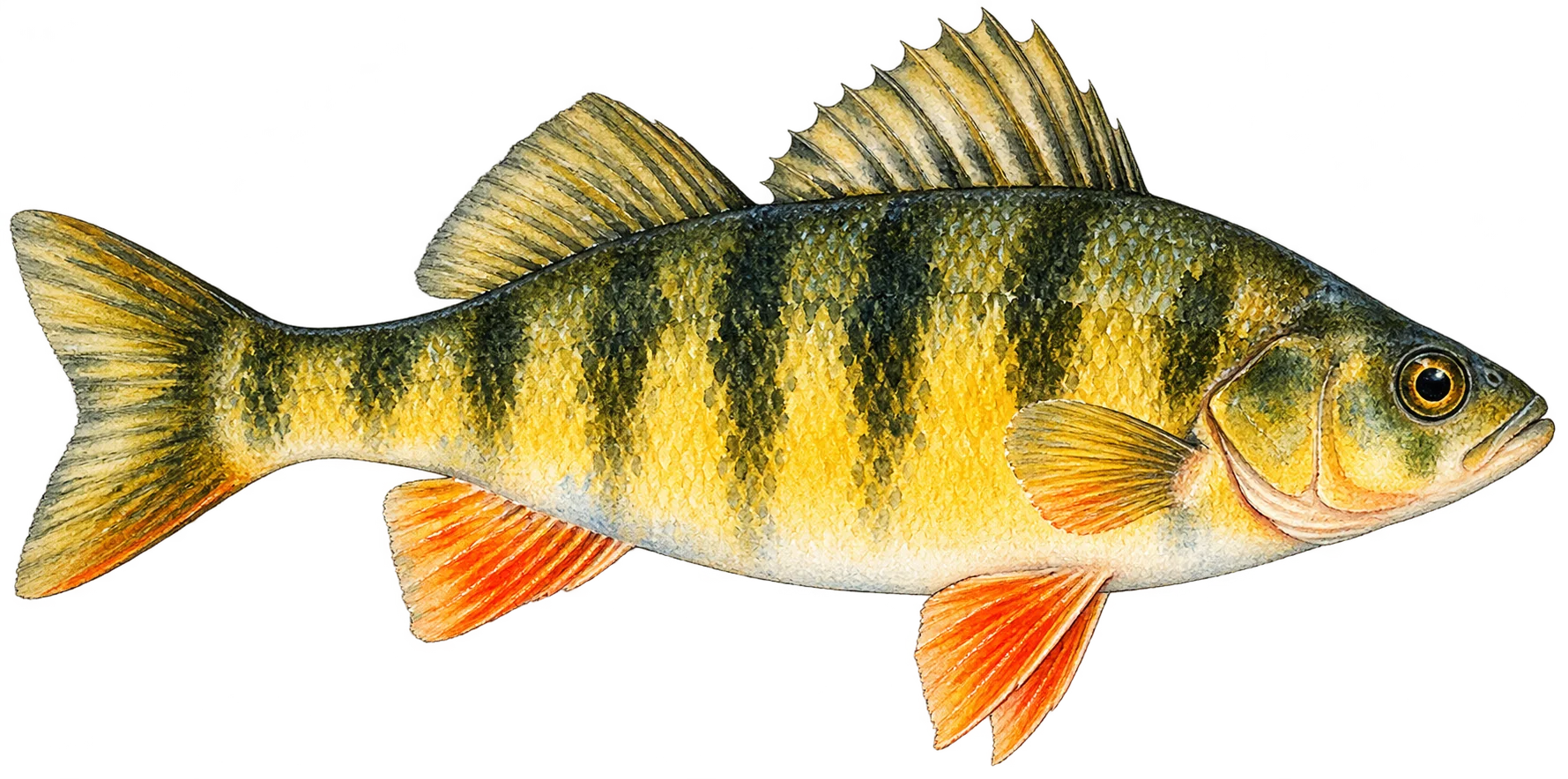
Perca flavescens · also called ringed perch, jack perch, raccoon perch
How to tell it
- A golden-yellow side with six to eight dark bars running down from the back.
- Two separate dorsal fins, the front one spiny.
- Orange to red-orange lower fins, brightest in spring.
Size: Most are 6–10 inches. A 12-inch “jumbo” perch, close to a pound, is what everyone hopes for.
What to throw
The first pick and the backup for every water clarity and light, from the Gear Matcher. Tap one to see the whole kit.
Lake · Transition water (50–65°F)
Clear water · see 4 ft+ down
Stained water · 1–4 ft of sight
Murky water · under 1 ft
Rain fishes like a cloudy day, so it is left out. These are the everyday picks: in spring and fall the Gear Matcher adds the season’s patterns for some fish.
Our picks for these
- Small Jig tipped with a Minnow or Worm: Dr.Fish crappie jig heads, 1/16 oz, chartreuse, 10 pack
- Mini Drop Shot Rig: THKFISH drop-shot weights and hooks kit, 28 pack
- Small Inline Spinner: Worden's Rooster Tail, 1/16 oz, white
- Live Minnow under a Lighted Bobber: QualyQualy lighted slip bobbers, 5 pack
- Small Jig near a Submersible Light: Linkstyle green underwater fishing light
- Live Minnow under a Slip Bobber: Thill Pro Series slip bobber rig kit
- Nightcrawler on a Two-Hook Perch Rig: J Deez Perch Pounder two-hook rig, size 4
Rod, reel and line
- Rod
- 6'–7' ultralight spinning
- Reel
- 1000 spinning
- Line
- 4–6 lb monofilament or fluorocarbon
Perch bite lightly. An ultralight rod shows the bite and casts small jigs well.
Where and when
Lake fishing: plan your approach and read the water.
- Where they live
- Clear, cool lakes with weeds and sand or gravel bottoms, slow rivers, and the Great Lakes. They roam weed edges and flats in schools, near the bottom.
- Water they like
- Most active from 60 to 75°F, but they feed all year, under the ice too.
- Best time
- Daytime: perch feed by sight, best in the morning and afternoon. They rarely bite after dark.
- Spawning
- Early spring, at about 45–50°F, often right after ice-out: females drape long ribbons of eggs over weeds and brush.
Through the year
Best months for yellow perch: January–February and October–November.
- January: best.
- February: best.
- March: good.
- April: good.
- May: slower.
- June: slower.
- July: slower.
- August: slower.
- September: good.
- October: best.
- November: best.
- December: good.
Through the ice is one of the best times in the North. In summer, drift until you find a school.
A general pattern, not a local forecast. Ice, runs, stocking and the rules set the season for yellow perch, water by water.
Spring
Into the shallows right after ice-out to spawn: small jigs and minnows near weeds and wood.
Summer
Out on deeper weed edges and flats, often 10–25 feet depending on the lake. Drift until you find a school, then stop.
Fall
Schooled up and feeding hard on weed edges: one of the best times of the year.
Winter
A favorite fish through the ice: small spoons and jigs tipped with a minnow head or wax worm, on the bottom.
Tips
- 1.Keep the bait right on the bottom or just above it: that is where perch feed.
- 2.When you catch one, stop and work the same spot; the school is around you.
- 3.Bring small hooks and minnows: a 1/16 oz jig with a minnow catches perch almost everywhere.
The rules
Check local regulations. Some waters limit live bait.
Through the ice
What to drop
Small Jigging Spoon with a Minnow Head
or Tiny Tungsten Jig with a Wax Worm or Spike
- Rod
- 24"–28" ultralight ice rod
- Reel
- 500 spinning
- Line
- 2–4 lb monofilament or fluorocarbon
How thick the ice must be
- Under 4"Stay off
- 4"Ice fishing and anything on foot
- 5–7"Snowmobile or ATV
- 8–12"Car or small pickup
- 12–15"Medium truck
For new, clear ice. White or snowy ice is about half as strong, so double these. Check it with a spud bar or auger as you go out, and keep off ice over moving water, near inlets and at pressure ridges. No ice is completely safe.