U.S. freshwater · Beginner guide
Fishing a pond
Work the water you can reach: choose a bank position, investigate a nearby feature, and compare a few deliberate casts.
Reviewed October 20, 2026 · Confirm species, access and current rules for your actual water.
Make a small bank plan
Start with a documented target and an allowed place to fish. Confirm the entrance, opening hours and rules with the owner or managing agency. A place called a pond is not necessarily small, shallow or open to the public.
From a stable bank position, choose one feature you can cast to and a place where you could land a fish. Check behind you for people and branches. You do not need to circle the entire pond or cast to its center.
Missouri’s pond guidance describes observing quietly and investigating different shoreline sections. Use that as a starting approach: compare reachable water, and move only along a route you are allowed to use.
- Choose a target known to live in this pond.
- Pick a usable bank position and one nearby feature.
- Choose a presentation for that fish and cover.
- Compare the angle, depth or retrieve before trying another permitted position.
Sources: Missouri conservation: exploring pond water (opens in a new tab)
Read the edges within reach
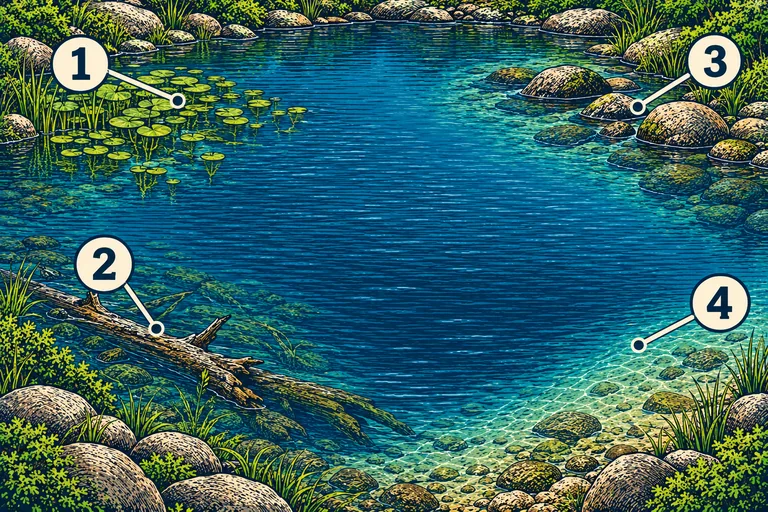
Vegetation, wood and rocks can offer shelter or concentrate food. Look at their edges and nearby open water; the presence of cover does not prove fish are there.
- 1 · Vegetation edge
- Compare an opening with the outside edge. Choose a presentation that can pass through without collecting plants on every cast.
- 2 · Partly submerged wood
- Investigate adjacent water from a stable bank. The log is cover, not a place to climb or stand.
- 3 · Shoreline rocks
- Try the nearby water without scrambling over wet or unstable rocks to get closer.
- 4 · Shallow bank edge
- Compare the visible margin with adjacent open water. The illustration cannot tell you the slope, depth or footing of a real pond.
Sources: NYDEC: where to fish in lakes and ponds (opens in a new tab)
Choose a documented fish
Use these as starting options only where the species is documented and the method is allowed. A stocked-trout pond, a bass pond and a sunfish pond are different outings.
Bluegill
Try a small worm portion under a float beside reachable cover. Set the bait clear of vegetation rather than using one depth for every pond.
Largemouth bass
Try a soft plastic suited to the available cover. Work an edge or opening before casting into dense plants; the rigging must suit that cover.
Trout
Where trout are stocked or otherwise documented, a retrieved spinner or permitted bait presentation offers a starting option. Check bait and hook restrictions first.
Sources: NYDEC: fishing for panfish (opens in a new tab) · NYDEC: fishing for bass (opens in a new tab) · ODFW: how to fish for trout (opens in a new tab)
Compare casts, not just products
With the chosen presentation, compare a cast beside the feature with a cast into adjacent open water. Keep the rest of the setup the same so you can notice what changed.
With a float, change its setting to investigate a different depth while keeping the bait clear of cover. With a retrieved lure, vary the angle, retrieve speed or time allowed to sink. Use the selected lure’s instructions; not every lure sinks or works at the same speed.
If you move, choose another legal bank position with usable casting and landing room. A longer cast is not automatically a better search. No bites on a few casts cannot establish that the pond has no fish.
When the first position is difficult
- Plants on the hook: inspect and clear it, then try an opening or a presentation appropriate for that cover.
- No casting or landing room: choose another permitted position. Do not push through private shoreline or stand on submerged wood.
- No response: compare another reachable feature and confirm your target is documented before buying more tackle.
- Deteriorating conditions: leave unstable edges and seek suitable shelter when thunder threatens. Check the forecast before the outing.
For a larger search area, read the lake fishing guide. For a moving-water outing, start with the creek guide.
Sources: National Park Service: river and stream safety (opens in a new tab) · National Weather Service: inland boating (opens in a new tab)
Put the plan into practice
Keep your chosen fish and set the Matcher to pond fishing. Update the clarity and conditions yourself; this guide does not know the water’s current conditions.