Fish guide
Walleye
The favorite fish of the northern lakes and big rivers, and one of the best to eat. Walleye see well in dim light, so they feed most at dusk, at night and in stained water.
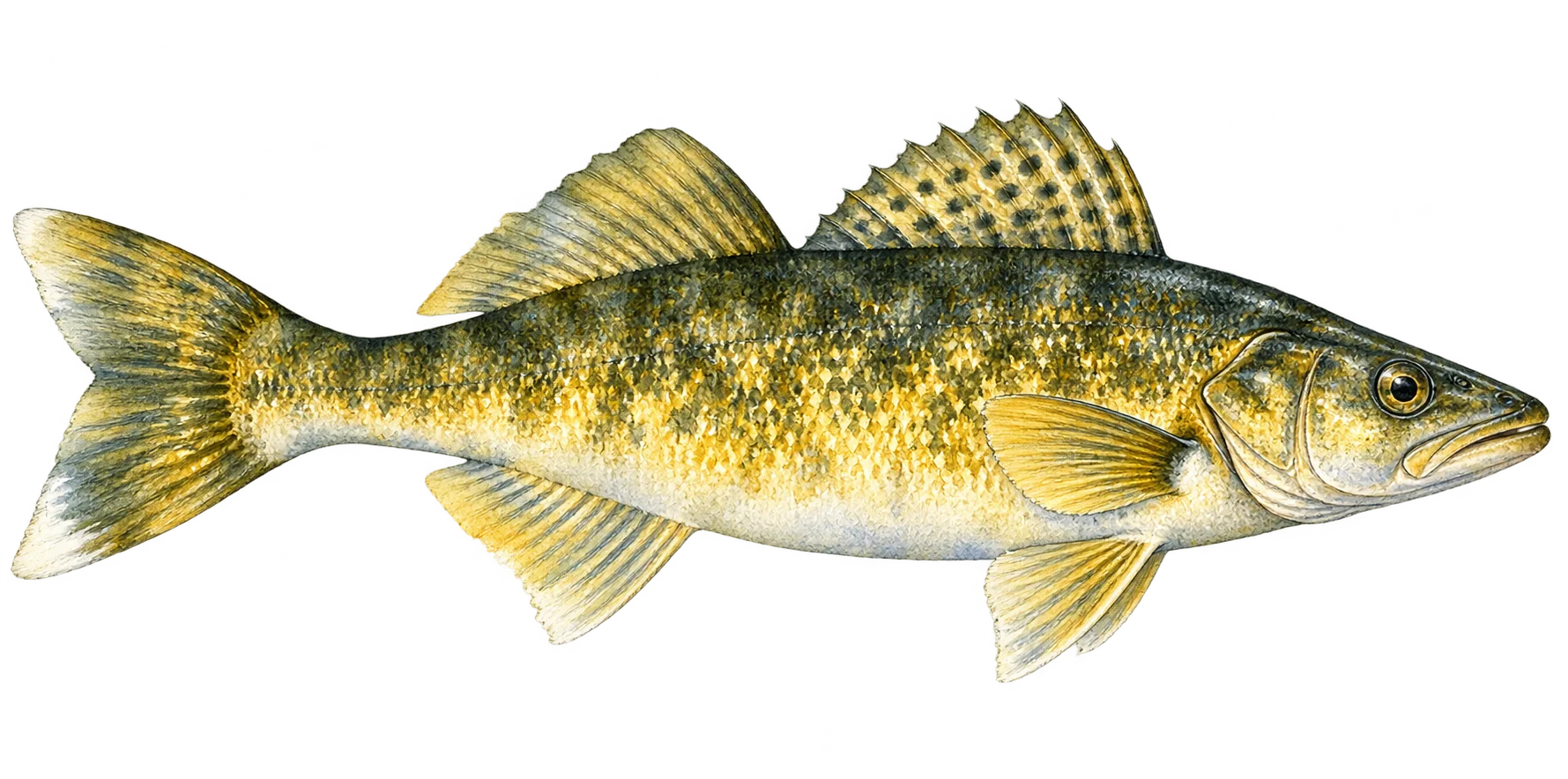
Sander vitreus · also called walleyed pike, pickerel (in Canada), marble eyes
How to tell it
- Big, glassy, reflective eyes.
- Olive to golden sides, a white belly, and a white tip on the lower lobe of the tail.
- Two separate dorsal fins, the first spiny with a dark blotch at its back, and sharp teeth.
Size: Most are 14–20 inches and 1–3 lb; a 10-pounder is a trophy.
What to throw
The first pick and the backup for every water clarity and light, from the Gear Matcher. Tap one to see the whole kit.
Lake · Transition water (50–65°F)
Clear water · see 4 ft+ down
Stained water · 1–4 ft of sight
Murky water · under 1 ft
Rain fishes like a cloudy day, so it is left out. These are the everyday picks: in spring and fall the Gear Matcher adds the season’s patterns for some fish.
Our picks for these
- Jig and Minnow: Northland Fire-Ball jig, 1/4 oz, assorted colors
- Bottom Bouncer with Crawler Harness: Berkley walleye crawler harness, Colorado blades
- Shallow Minnow Crankbait or Jerkbait: Rapala Original Floating F09, Metallic Silver
- Jig and Minnow: Dovesun glow jig heads, 1/4 oz, 25 pack
- Live Bait under a Lighted Slip Bobber: QualyQualy lighted slip bobbers, 2 in, 4 pack
- Crankbait: Rapala Shad Rap, #7, firetiger
- Crankbait: Rapala Shad Rap SR08, Blue
- Jig and Minnow: Northland Fireball jig, glow watermelon
- Glow Chartreuse / Orange Jig with Grub or Minnow: VMC Neon Moon Eye jig, 3/8 oz, glow chartreuse
Rod, reel and line
- Rod
- 6'6" medium-light spinning
- Reel
- 2500 spinning
- Line
- 8 lb braid
- Leader
- 8 lb fluorocarbon
Braid lets you feel light walleye bites, and the fluorocarbon leader keeps it invisible.
Where and when
Lake fishing: plan your approach and read the water.
- Where they live
- Large lakes, reservoirs and rivers: gravel and rock bottoms, weed edges, points and drop-offs. They roam in schools, often near the bottom, and sometimes suspended over deep water after baitfish.
- Water they like
- Most active from 55 to 70°F.
- Best time
- Dusk into dark, dawn, and windy or cloudy days (anglers call the wind’s ripple a “walleye chop”).
- Spawning
- Very early spring, right after ice-out, at about 42–50°F, over gravel and rock in rivers and on windblown shorelines. Many states close the season until after the spawn.
Through the year
Best months for walleye: May–June and October–November.
- January: good.
- February: good.
- March: slower.
- April: slower.
- May: best.
- June: best.
- July: slower.
- August: slower.
- September: good.
- October: best.
- November: best.
- December: slower.
The spring spawning run (March and April, later in the North) can be good where the season is open, but many states close it until after the spawn, and the opener is set by each state: check yours. In summer, fish dusk into dark.
A general pattern, not a local forecast. Ice, runs, stocking and the rules set the season for walleye, water by water.
Spring
Rivers below dams and over gravel: a jig and a minnow.
Summer
Deeper structure by day (15–30 feet) and shallow at night: live-bait rigs on bottom bouncers, and trolled crankbaits.
Fall
Shallow again and feeding hard: jigs and minnows along rock and weed edges, best at dusk.
Winter
A top fish through the ice: jigging spoons, and minnows on tip-ups near drop-offs, at dawn and dusk.
Tips
- 1.Start near the bottom, but watch the sonar: walleye suspend after baitfish too, so fish the depth where the bait is.
- 2.Wind is your friend: a windblown shore stirs up food and dims the light.
- 3.Set the hook on any tick or weight: walleye bites are often soft.
The rules
Spawning season: many states close bass, walleye or pike fishing, or make it catch-and-release, until an opener. Leave fish on their beds alone. Check local regulations.
Through the ice
What to drop
Jigging Rap or Jigging Spoon tipped with a Minnow Head
or Live Minnow under a Tip-Up
- Rod
- 28"–32" medium-light or medium ice rod
- Reel
- 1000 spinning
- Line
- 6–8 lb fluorocarbon (or 10 lb braid with a fluorocarbon leader)
How thick the ice must be
- Under 4"Stay off
- 4"Ice fishing and anything on foot
- 5–7"Snowmobile or ATV
- 8–12"Car or small pickup
- 12–15"Medium truck
For new, clear ice. White or snowy ice is about half as strong, so double these. Check it with a spud bar or auger as you go out, and keep off ice over moving water, near inlets and at pressure ridges. No ice is completely safe.